
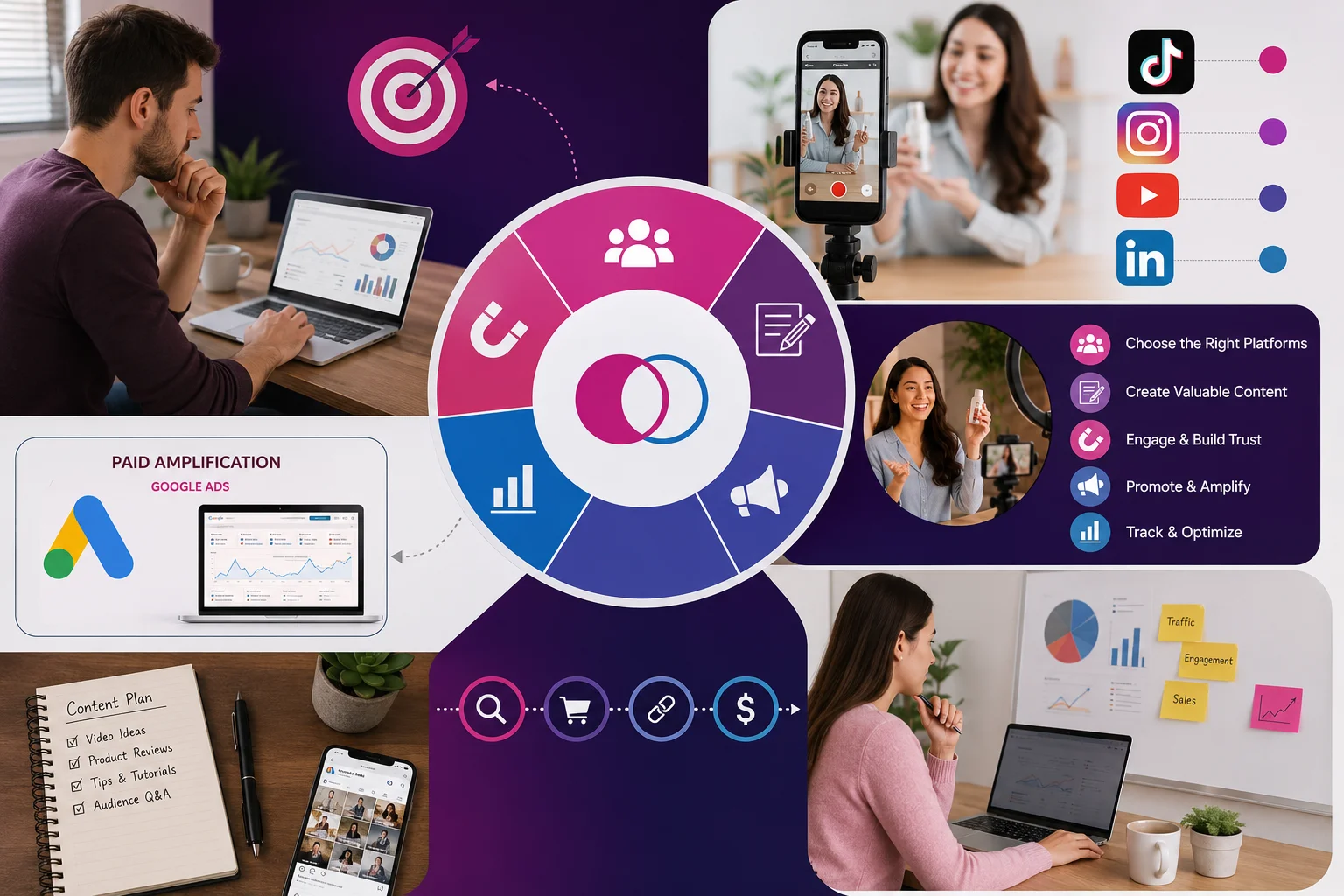
If you've spent any time in the affiliate world over the last year, you've probably noticed the ground shifting under your feet. The old playbook, a niche blog, a handful of SEO articles, and a trickle of Amazon commissions, still works, but it's no longer where the real growth is happening. In 2026, affiliate marketing social media promotion strategies 2026 are the difference between an affiliate business that earns a few hundred dollars a month and one that scales into a full-time income. Platforms like TikTok, Instagram, YouTube Shorts, and even LinkedIn have become discovery engines that rival Google itself, and smart affiliates are meeting their audience exactly where they already spend their time.
This guide walks through everything you need to know about social media affiliate marketing in plain, practical language, no fluff, no recycled advice. We'll cover how to choose the right platforms, build a content system that compounds over time, and use paid amplification (including Google Ads) to push your best-performing posts further. We'll also address a question a lot of beginners ask: what if you don't want to build a personal brand on camera? We'll cover affiliate marketing without social media as a legitimate alternative path, so you can decide which route actually fits your strengths and goals.
Whether you're just starting out or you already run a modest affiliate site and want to layer in social distribution, this article gives you a realistic, step-by-step framework, not vague theory, for turning affiliate marketing on social media into a predictable, repeatable channel.
Why Social Media Has Become the New Front Door for Affiliate Marketing
Search engines answer questions people already know they have. Social platforms surface products and ideas people didn't know they wanted, until a creator they trust shows it to them. That's the core reason affiliate marketing social media campaigns often convert faster than cold organic search traffic: the recommendation arrives inside a relationship, not a query box.
Algorithms across every major platform now favor short, native video, which means a well-made 30-second demo can reach thousands of untapped viewers overnight, something that almost never happens with a blog post. Add to that the rise of shoppable posts, in-app checkout, and creator storefronts, and it's clear why so many brands are rebuilding their entire funnel around affiliate marketing for social media rather than treating it as an afterthought.
"The affiliates winning in 2026 aren't the ones with the biggest budgets, they're the ones who post consistently and trust the platform's distribution engine to do the heavy lifting."
Choosing the Right Platforms for Your Niche
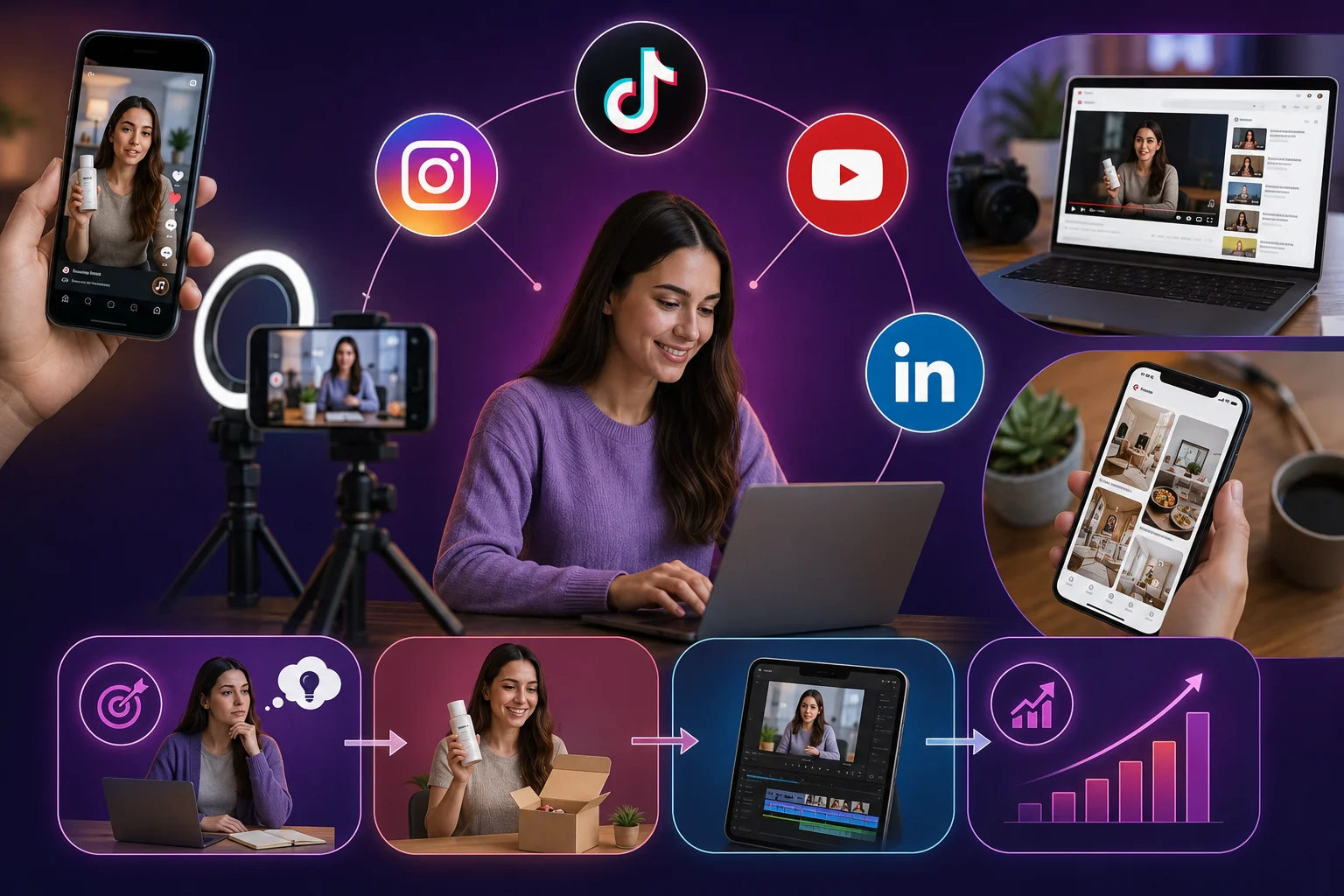
Not every platform suits every product. Before you commit to a content calendar, spend a week actually studying where your target buyer already hangs out. Below is a quick reference for matching niches to platforms when you're planning affiliate marketing on social media campaigns.
| Platform | Best For | Content Format |
|---|---|---|
| TikTok | Beauty, gadgets, fashion, impulse buys | Short native video, trends |
| Lifestyle, home, wellness, fashion | Reels, carousels, Stories | |
| YouTube | Tech, software, high-ticket reviews | Long-form review, Shorts |
| Home decor, recipes, DIY, planning | Static pins, idea pins | |
| SaaS, B2B tools, courses | Text posts, carousels |
Pick one primary platform and one secondary platform. Trying to be everywhere at once is the single most common reason new affiliates burn out before they see results.
Building a Content System That Actually Compounds
Random posting doesn't work. Sustainable social media affiliate marketing runs on a repeatable system, not one-off viral hopes. Here's the structure that consistently performs well across niches.
1. The Problem-Aware Hook
Every post should open with the exact problem your audience is already thinking about, not the product. "Why your skin still breaks out even after switching cleansers" earns more attention than "Check out this new serum." The product enters as the solution, not the subject.
2. The Demonstration
Show the product in real use. Unboxing, before/after, side-by-side comparisons, and screen recordings consistently outperform polished studio shots because they read as authentic rather than promotional.
3. The Soft CTA
Point viewers to "link in bio" or a pinned comment rather than hard-selling in the caption. Platforms increasingly suppress posts that push external links too aggressively in the caption itself, so keeping the promotional ask light protects your reach.
4. The Repost-and-Repurpose Loop
One piece of raw footage can become a TikTok, a Reel, a YouTube Short, and a Pinterest idea pin. This is where a bit of Web Development or automation know-how pays off, even a simple script that auto-crops and reformats video for each platform's aspect ratio saves hours every week.
Building Trust Before You Ever Mention a Commission
Audiences can smell a pure sales pitch from a mile away. The affiliates who last are the ones who build a recognizable point of view first, a consistent aesthetic, a consistent tone, a consistent promise about what kind of recommendations they make. This is essentially Brand Awareness work applied to a personal or niche account rather than a company page, and it pays off the same way: people buy from accounts they already trust, not accounts they just discovered.
If you're promoting on behalf of a company or managing multiple creator accounts, investing in proper Branding & Identity, consistent colors, fonts, and voice, makes your content instantly recognizable in a crowded feed, which compounds trust every time someone scrolls past your post a second or third time.
Using Paid Ads to Amplify What Already Works
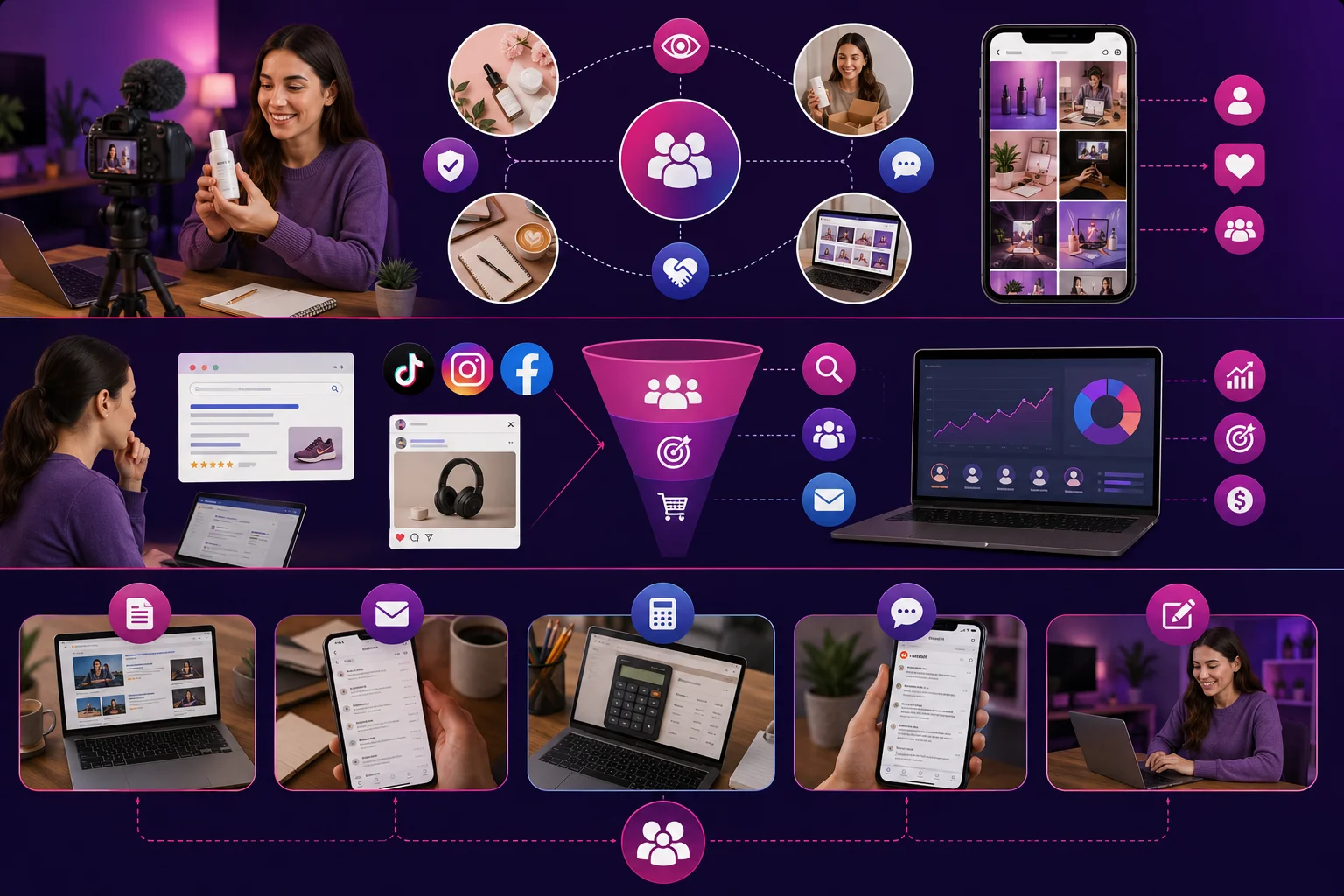
Once you have organic posts that are already converting, paid amplification is where the real scale happens. Rather than guessing at cold audiences, boost your proven winners. Running Google Ads alongside native platform ads lets you capture people actively searching for the product you're reviewing, while your social content builds broader awareness at the same time. This combined approach, search intent plus social discovery, is one of the most effective affiliate marketing social media promotion strategies 2026 has to offer, and it's far more efficient than relying on either channel alone.
A broader Digital Marketing strategy ties these pieces together: organic social builds trust and reach, paid ads capture intent, and email or retargeting closes the loop with people who clicked but didn't buy on the first visit.
What If You Don't Want to Be on Camera? Affiliate Marketing Without Social Media
Not everyone wants to film themselves talking to a phone every day, and that's completely fine. affiliate marketing without social media is still a legitimate, profitable path in 2026, it simply relies on different channels doing the discovery work that social platforms would otherwise handle.
The most reliable alternatives include:
- SEO-driven content sites:
- In-depth comparison and review articles that rank on Google and answer buyer-stage questions directly.
- Email newsletters:
- A weekly list of curated deals or recommendations sent directly to a subscriber's inbox, with zero need for a public-facing personality.
- Niche comparison tools or calculators:
- A small interactive tool built with basic Web Application skills, a savings calculator or product finder, can quietly drive affiliate clicks for years with almost no ongoing maintenance.
- Marketplace and forum presence:
- Answering questions on Reddit, Quora, or niche forums where genuine recommendations are welcomed rather than seen as spam.
These channels are slower to build than a viral TikTok, but they tend to be more durable, an SEO article can keep generating commissions two or three years after it's published, long after a social post has scrolled out of anyone's feed.
The Hybrid Approach: Combining Both Worlds
In practice, the strongest affiliate businesses rarely pick one lane and stay there forever. Many successful creators start with affiliate marketing without social media, a small content site or newsletter, and only add social distribution once they have a proven product angle worth promoting at scale. Others go the opposite direction, building an audience on TikTok or Instagram first and later launching a website to house evergreen content and capture search traffic.
If you're running an online store alongside your affiliate content, tying your social promotion into your own E Commerce storefront, rather than only linking out to someone else's product page, lets you capture both the affiliate commission and any upsell or repeat-customer value from your own catalog.
Why Video Content Outperforms Static Posts in 2026
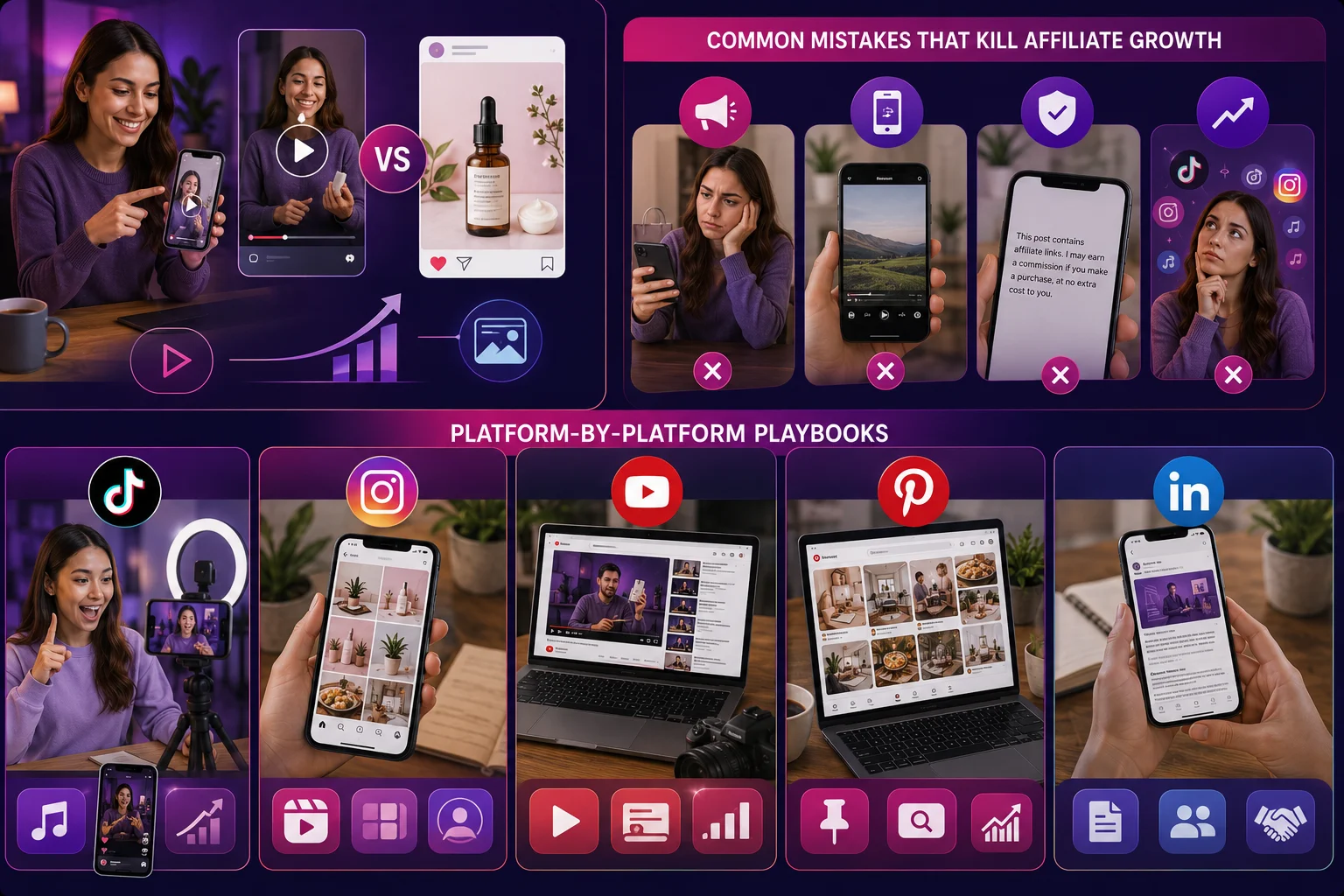
Across nearly every platform, video continues to receive priority placement in feed algorithms compared to static images or plain text posts. For affiliates without the time or budget to film constantly, professionally produced Video Animation content, explainer clips, product walkthroughs, or comparison graphics, can fill the gap between raw phone footage and a full production budget, while still giving the algorithm the video format it favors.
A simple rule of thumb: if a product benefit is hard to describe in words but easy to show in five seconds of footage, it belongs in a video, not a caption.
Common Mistakes That Quietly Kill Affiliate Growth on Social Media
Posting Only When You Have a Sale to Promote
Accounts that only show up during promotions read as transactional, and audiences respond accordingly, with silence. Consistent value-first content earns the trust that makes promotional posts convert when they do appear.
Ignoring Platform-Native Formats
Repurposing a YouTube video as-is into a TikTok almost always underperforms. Each platform rewards content that feels built for it, not repurposed onto it.
Skipping Disclosure
Clear affiliate disclosure isn't just a legal requirement in most regions, it also builds trust rather than damaging it. Audiences are far more forgiving of a disclosed recommendation than a discovered undisclosed one.
Chasing Every Trend
Jumping on every trending sound or format without connecting it back to your niche dilutes your audience's understanding of what you're actually about, which hurts long-term trust more than it helps short-term reach.
Platform-by-Platform Playbooks
General advice only goes so far. Each platform has its own culture, algorithm quirks, and audience expectations, so treating them identically is one of the fastest ways to underperform. Below is a closer look at how to adapt your approach to affiliate marketing social media promotion for each of the major networks.
TikTok: Speed, Relatability, and Trend-Jacking
TikTok rewards raw, fast, and relatable content over polish. The first 1.5 seconds of a video determine whether someone keeps watching, so open with the payoff or the problem, never with a slow intro. Native trends, sounds, and formats can be adapted to almost any niche, a trending transition can just as easily showcase a skincare routine as a productivity app. Because TikTok's algorithm distributes content based on engagement rather than follower count, even brand-new accounts can reach thousands of viewers with a single well-timed post, which makes it one of the most beginner-friendly platforms for anyone starting affiliate marketing on social media from zero.
Instagram: Aesthetic Consistency and Carousel Depth
Instagram audiences respond well to a cohesive visual identity, which is why creators who invest early in a consistent color palette, filter style, and caption voice tend to build recognition faster than those who post inconsistently. Reels drive discovery, but carousels, multi-image posts that walk through a comparison, a tutorial, or a "5 reasons why" list, consistently generate strong saves and shares, both of which the algorithm treats as strong trust signals. Stories, meanwhile, are the best place for the softer, more direct "swipe up" or "link in bio" calls to action that would feel too promotional in a main feed post.
YouTube: Long-Form Trust and Search Discoverability
YouTube functions as both a social platform and a search engine, which makes it uniquely valuable for affiliates. A well-optimized long-form review can rank in YouTube search for months or years, continuing to generate clicks long after the upload date. Shorts, meanwhile, can be used to tease longer reviews or highlight a single standout feature, funneling viewers toward the full video where the affiliate link lives in the description. Because YouTube viewers tend to be in a more research-driven, comparison-shopping mindset, this platform performs especially well for higher-ticket items, electronics, courses, software, and appliances, where buyers want depth before they commit.
Pinterest: The Quiet, Long-Tail Traffic Engine
Pinterest is frequently overlooked, but it behaves more like a visual search engine than a traditional social network, and a single well-designed pin can continue driving traffic for years. This makes it an excellent complement to a content site built around affiliate marketing without social media principles: pins can point directly to blog posts or product roundups, combining the discovery power of a visual platform with the durability of evergreen written content.
LinkedIn: Underrated for B2B and SaaS Affiliates
For affiliates promoting software, business tools, or online courses, LinkedIn offers a highly qualified, professionally minded audience with far less competition than the consumer-facing platforms. Text-based posts and simple carousel PDFs tend to outperform flashy video here, since the audience is looking for credibility and insight rather than entertainment.
Turning Followers Into Buyers: The Funnel Behind the Feed
Posting content is only the visible half of a working affiliate system. Behind every high-converting account is a simple funnel that quietly does the work of turning a casual scroller into a paying customer.
Step One: The Link-in-Bio Hub
Rather than sending every visitor to a single affiliate link, a link-in-bio landing page lets you organize offers by category, feature your top picks, and track which products are actually generating clicks. This small piece of infrastructure, essentially a lightweight Web Application, often lifts conversion rates simply because it gives visitors options instead of a single all-or-nothing link.
Step Two: The Landing or Comparison Page
For higher-consideration products, sending traffic straight to a merchant's page skips an important trust-building step. A short comparison page, even a simple one built with basic Web Development skills, that explains why you recommend a specific option over its competitors gives undecided buyers the reassurance they need before clicking through to purchase.
Step Three: Retargeting and Follow-Up
Most visitors will not buy on their first click. Email capture, retargeting pixels, and simple follow-up sequences recover a meaningful share of that lost traffic, turning what would otherwise be a one-time impression into a repeated touchpoint that eventually converts.
Building a Sustainable Content Calendar
Consistency beats intensity, but consistency without a plan quickly turns into burnout. A simple weekly framework keeps affiliate marketing for social media sustainable rather than exhausting:
- Two problem-aware hooks that open with a pain point your audience already recognizes.
- Two product demonstrations showing real, hands-on use rather than staged marketing shots.
- One comparison or listicle-style post that positions your recommended product against alternatives.
- One purely value-driven post with no promotion at all, simply to reinforce trust and expertise.
Batching content one day per week, filming, editing, and scheduling several posts at once, is far more sustainable long-term than trying to create from scratch every single day, and it also protects your consistency during weeks when life gets busy.
Disclosure, Compliance, and Long-Term Trust
Regulators in most major markets require clear, unambiguous disclosure whenever a post includes a paid or commissioned link, and platforms themselves increasingly enforce this through built-in "paid partnership" or "includes affiliate links" labels. Beyond the legal requirement, disclosure has a quiet marketing benefit: audiences consistently report trusting creators who are upfront about commissions more than those who are later discovered to have hidden them. Treat disclosure as a trust-building feature of your content, not an obligation to bury in fine print.
Measuring What Actually Matters
Follower count is a vanity metric. The numbers that actually predict revenue from affiliate marketing for social media are click-through rate on your bio link, conversion rate on the landing page you send traffic to, and earnings per click across your top-performing posts. Track these weekly, and double down on the content formats that move them, not the ones that simply get the most likes.
The Practical Toolkit Behind a Working Affiliate System
Behind almost every affiliate account that looks effortless, there's a small, unglamorous stack of tools handling the parts that don't show up on camera. A link management tool cloaks and tracks your affiliate links so you know exactly which post drove which sale. A scheduling tool lets you batch a week or a month of posts in a single sitting rather than manually publishing every day. A basic analytics dashboard, even a simple spreadsheet pulling numbers from each platform, turns scattered stats into a weekly decision-making habit rather than a once-a-quarter guessing game.
For affiliates who eventually want to own more of their funnel instead of renting it entirely from social platforms, building out even a lightweight website, supported by proper Web Development, turns a collection of scattered social posts into a searchable, evergreen library of content that keeps working long after any individual post has faded from the feed.
A Realistic Example: Six Months of Growth
Consider a hypothetical creator starting from zero in a home-organization niche. In month one, they post daily on TikTok using simple phone footage, focusing entirely on problem-aware hooks and honest product demonstrations, without expecting significant income yet. By month two, a handful of posts begin gaining consistent views, and the creator starts noticing which specific angles, before-and-after transformations, in particular, reliably outperform the rest.
In months three and four, they build a simple link-in-bio page, start a small weekly newsletter to capture repeat visitors, and repurpose their best TikToks into Instagram Reels and Pinterest pins, extending each piece of content's shelf life well beyond its original platform. By month five, with a handful of proven top performers identified, they begin lightly boosting those specific posts rather than spreading a budget thin across untested content.
By month six, the account isn't viral in the traditional sense, it has a modest but loyal following, yet it generates a steady, predictable stream of affiliate income because every piece of the system, from the hook to the landing page to the follow-up email, has been deliberately built and tested rather than left to chance. This is the realistic trajectory most durable affiliate accounts follow, and it looks far less dramatic, and far more repeatable, than the overnight-success stories that tend to dominate headlines.
Where Affiliate Marketing on Social Media Is Headed Next
A few shifts are worth watching closely as platforms continue to evolve. In-app checkout is expanding well beyond its early adopters, meaning fewer users ever leave the platform to complete a purchase, which will keep rewarding creators who build directly within a platform's native shopping tools rather than routing everyone off-site. AI-assisted video editing is lowering the production barrier further, letting creators without editing experience produce polished demonstrations in minutes rather than hours. And niche, smaller-audience creators, sometimes called micro or nano affiliates, continue to see disproportionately strong engagement and conversion rates compared to mega-influencers, because their recommendations feel personal rather than transactional.
"Scale used to mean reach. In 2026, scale increasingly means trust, and trust is built one honest, well-made post at a time."
Final Key Points
There's no single "correct" way to run an affiliate business in 2026. Some creators will thrive building a personality-driven presence across TikTok and Instagram; others will do just as well, sometimes better, with a quiet, SEO-first approach that never requires a camera. What matters most is choosing a lane that matches your strengths, building a repeatable content system rather than chasing one-off viral moments, and layering in paid amplification once you know exactly which content converts. Whether you lean fully into affiliate marketing on social media or build a quieter content engine instead, consistency will always outperform intensity.
Is affiliate marketing on social media still profitable in 2026?
Yes. Platforms continue to prioritize video content and shoppable posts, and audiences increasingly discover products through creators they trust rather than through search alone, making social channels one of the most effective affiliate distribution methods available today.
Which platform is best for beginners starting affiliate marketing on social media?
TikTok and Instagram Reels tend to offer the fastest organic reach for new accounts because their algorithms actively promote fresh content to new audiences, regardless of follower count.
Can I really do affiliate marketing without social media?
Absolutely. SEO content sites, email newsletters, and forum participation all remain viable, and often more durable, alternatives that don't require an on-camera presence.
How many posts per week should I publish for social media affiliate marketing?
Most successful affiliate accounts post between four and seven times per week on their primary platform, prioritizing consistency over volume.
Do I need to disclose affiliate links on social media?
Yes. Clear disclosure is required in most regions and consistently builds more trust than it costs, since audiences respond better to transparent recommendations.
Should I run paid ads alongside organic affiliate content?
Once you've identified organic posts that convert well, boosting them or running complementary search ads is one of the most efficient ways to scale results without starting from zero on a cold audience.
What's the biggest mistake new affiliates make on social media?
Posting inconsistently and only promoting during sales, which trains the algorithm and the audience to associate the account with pure selling rather than genuine value.
How long does it take to see real income from affiliate marketing for social media?
Most creators report meaningful, repeatable income after three to six months of consistent posting, though timelines vary significantly by niche and platform.
For more questions?
Contact Us