


If you sell to businesses instead of consumers, you already know that b2b marketing social media doesn't work the same way as B2C. Nobody scrolls LinkedIn on their lunch break looking to buy enterprise software the way they'd browse Instagram for sneakers. B2B buyers are slower, more skeptical, and answer to a committee before they sign anything. That's exactly why a sloppy, one-size-fits-all b2b social media marketing strategy falls flat, and why the companies that actually generate pipeline from social media treat it as a long game, not a content calendar filled with random posts.
This guide breaks down everything you need to build a working b2b marketing social media strategy from scratch: platform choices, content types that actually convert, b2b social media marketing best practices backed by real results, and a step-by-step answer to the question every marketing manager eventually googles, how to use social media for b2b marketing without wasting a quarter's budget on posts nobody reads.
Whether you run marketing for a SaaS startup, a manufacturing firm, or a professional services agency, the fundamentals of a solid social media marketing strategy for b2b stay the same. What changes is execution. We'll cover both, the strategy layer and the tactical playbook, so you leave with something you can actually put into practice this week.
What Makes B2B Social Media Marketing Different From B2C
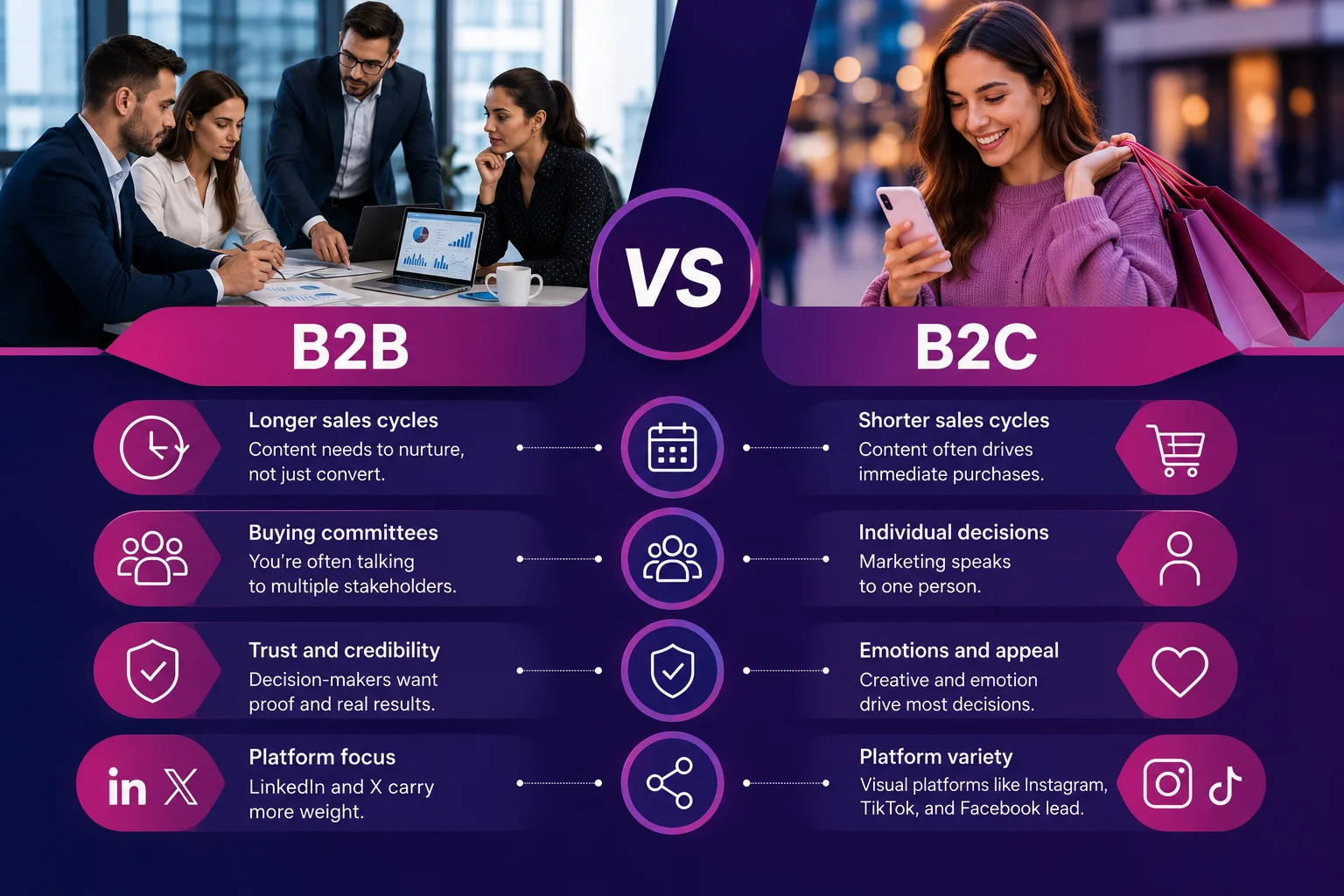
Before diving into tactics, it helps to understand why b2b-marketing social media campaigns need a different playbook. Consumer buyers make fast, emotional decisions. B2B buyers make slow, rational ones, usually involving multiple stakeholders, a procurement process, and a budget approval chain.
That changes what you post, how often, and what you're actually measuring. A viral consumer post might drive thousands of impulse purchases overnight. A great B2B post might just get you on the shortlist of three vendors a buyer reviews six months from now. Patience and consistency matter more than virality.
Key differences to keep in mind
- Longer sales cycles mean content needs to nurture, not just convert.
- Buying committees mean you're often talking to five people, not one.
- Trust and credibility outweigh flashy creative, decision-makers want proof, not hype.
- Platforms differ: LinkedIn and X carry more weight than Instagram or TikTok for most B2B categories.
Why B2B Marketing Strategies on Social Media Matter in 2026
Buyers now do most of their research before they ever talk to a salesperson. Gartner and Forrester have both reported that B2B buyers complete a majority of their purchase journey independently, researching vendors on LinkedIn, industry forums, and company pages long before a demo call happens. That's the single biggest reason b2b marketing strategies on social media have moved from "nice to have" to core pipeline infrastructure.
Social platforms are no longer just brand-awareness channels for B2B companies. They're where prospects vet your credibility, check what your customers say about you, and decide whether you're worth a conversation. If your social presence is thin or inconsistent, you're quietly losing deals to competitors who show up consistently.
How to Use Social Media for B2B Marketing: A Step-by-Step Framework

Here's the honest answer to how to use social media for b2b marketing the right way, not as a side project, but as a structured system with clear ownership and measurable outcomes.
Step 1: Define who you're actually talking to
Every effective b2b social media marketing strategy starts with a tight buyer persona, not a vague "marketing managers at mid-size companies" description, but specifics: job title, seniority, industry, the problems keeping them up at night, and where they spend time online. If you sell Web Development services to e-commerce brands, your audience is different from a company selling HR software to enterprises. Don't skip this step; it decides everything downstream.
Step 2: Pick the right platforms, don't spread thin
Most B2B brands try to be everywhere and end up mediocre everywhere. It's better to dominate two platforms than to post occasionally on five.
| Platform | Best For | Content That Performs |
|---|---|---|
| Lead generation, thought leadership, hiring, ABM | Founder posts, case studies, carousels, polls | |
| X (Twitter) | Industry commentary, product updates, PR | Threads, quick takes, engagement with journalists |
| YouTube | Long-form education, product demos | Tutorials, webinars, customer interviews |
| Instagram/Facebook | Employer branding, culture, events | Behind-the-scenes, team highlights, short reels |
For most B2B companies, LinkedIn should be the anchor platform. It has the highest concentration of decision-makers and the best organic reach for professional content, something X and Instagram struggle to match in the B2B space.
Step 3: Build a content mix that earns trust, not just attention
A strong b2b marketing social media strategy balances four content types so you're not just selling all the time:
- Educational content, how-to guides, industry breakdowns, and data-backed insights that answer real questions your buyers are searching for.
- Proof content, client case studies, testimonials, and results. Nothing sells B2B like evidence that you've solved this exact problem before.
- Thought leadership, opinions, predictions, and commentary from your founders or subject-matter experts. This builds authority faster than any polished ad.
- Behind-the-scenes content, team culture, product development, and process. This humanizes brands that otherwise feel corporate and faceless.
If you're producing explainer or product-demo content, a short, well-made Video Animation often outperforms a static graphic, B2B audiences are visual too, and motion holds attention longer than a wall of text.
Step 4: Create a realistic posting cadence
Consistency beats frequency. Three well-thought-out LinkedIn posts a week from a real person on your team will outperform daily posts from a faceless company page. Build a simple content calendar, assign ownership, and batch-create content monthly so you're never scrambling for something to post.
Step 5: Engage before you expect anyone to engage with you
Social media is not a broadcast channel, it's a conversation. Comment on prospects' posts, join relevant industry discussions, and respond to every comment on your own content within a few hours. Algorithms reward engagement, and buyers notice brands that actually show up in the comments, not just the feed.
Step 6: Pair organic content with paid amplification
Organic reach on LinkedIn and X has gotten harder every year. Once you know which posts resonate organically, put budget behind them. Running targeted campaigns through Google Ads alongside native LinkedIn ads lets you retarget the same audience across search and social, reinforcing your message at multiple touchpoints instead of relying on one channel to do all the work.
B2B Social Media Marketing Best Practices
These are the b2b social media marketing best practices that separate brands generating real pipeline from ones just posting for the sake of posting.
1. Let real people post, not just the company page
LinkedIn's algorithm consistently favors personal profiles over company pages. Posts from your founder, sales team, or subject-matter experts get significantly more organic reach than the same content posted from a brand account. Encourage your team to build their own presence, it compounds over time.
2. Lead with value, not a pitch
Nobody follows a B2B company for ads. They follow for insight. Every post should answer a real question or teach something useful before it ever mentions your product. Save the direct pitch for maybe one in every eight or ten posts.
3. Use data and original research
Original data, even something as simple as a small survey of your customers, gets shared and cited far more than generic advice. If you have access to product usage data or customer trends, turn it into a report or a series of posts. This is one of the fastest ways to build authority in a crowded niche.
4. Optimize your company page like a landing page
Your LinkedIn company page is often the first thing a prospect checks after seeing a post. Make sure your banner, About section, and pinned post clearly explain who you help and how. Treat it with the same care you'd give a Digital Marketing landing page, because functionally, that's what it is.
5. Track leading indicators, not just followers
Follower count is a vanity metric. Track profile visits from target accounts, comment quality, DM inquiries, and website clicks instead. These tell you whether your content is actually influencing buyers, not just accumulating passive views.
6. Repurpose long-form content into multiple posts
One well-researched blog post or webinar can become a week's worth of social content, a carousel, a quote graphic, a short clip, and a discussion post. This keeps your output consistent without demanding new ideas every single day.
7. Don't ignore employee advocacy
Employees have combined networks that dwarf your company page's followers. A simple employee advocacy program, sharing pre-approved posts your team can repost with their own commentary, multiplies your reach without extra ad spend.
Proven B2B Social Media Marketing Strategies That Work

Beyond best practices, here are specific b2b social media marketing strategies companies are using right now to generate qualified pipeline, not just impressions.
Account-Based Marketing (ABM) on LinkedIn
Instead of broadcasting to everyone, ABM-driven social strategies target a defined list of high-value accounts with tailored content, ads, and outreach. LinkedIn's targeting options make this especially effective for B2B companies selling higher-ticket products or services.
Founder-led content
Buyers trust people, not logos. Companies where the founder or CEO posts consistently, sharing lessons, opinions, and behind-the-scenes decisions, routinely outperform competitors who only post from a branded account.
Customer story series
Rather than a single case study buried on your website, break results into a short series: the problem, the process, the result, and a client quote. This turns one success story into four or five pieces of proof-driven content.
Interactive content: polls, questions, and carousels
Polls and open-ended questions consistently drive higher engagement than static posts because they're low-effort for the audience to respond to. Carousels perform especially well for step-by-step frameworks, checklists, and comparisons.
Community building through LinkedIn groups and newsletters
Owning a niche community, through a LinkedIn newsletter or a focused group, gives you a direct line to your audience that isn't at the mercy of algorithm changes. It's a long-term play, but one of the most defensible.
Building the Technical Backbone for Your Strategy
A social strategy doesn't operate in isolation, it needs to connect to the rest of your digital presence. Every post should ultimately point somewhere: a resource page, a case study, or a demo request. If your website is outdated or slow, even great content will lose prospects at the last step. Investing in solid Web Development and, where relevant, a custom Web Application for things like interactive calculators or client portals gives your social traffic somewhere worthwhile to land.
If your business sells products rather than services, your social content should link directly into a smooth E-Commerce experience, B2B buyers increasingly expect self-serve purchasing options, not just a "contact sales" form.
Brand Consistency: The Overlooked Half of B2B Social Success

Great content with inconsistent branding confuses buyers. Every post, graphic, and video should be instantly recognizable as yours, even without a logo in the corner. That means consistent colors, tone, and messaging across every platform. Strong Branding isn't a design exercise, it's a trust signal. When your Branding & Identity is consistent, buyers subconsciously associate that consistency with reliability, which matters enormously in B2B where the purchase risk is higher than a consumer impulse buy.
This is also where Brand Awareness campaigns tie back into social strategy. Awareness isn't just about being seen, it's about being remembered by the right people at the moment they start evaluating vendors, which is often months after their first exposure to your content.
Measuring What Actually Matters
Vanity metrics feel good but don't pay the bills. Here's a simple framework for tracking whether your social media marketing strategy for b2b is actually working.
| Metric | What It Tells You |
|---|---|
| Engagement rate on target-account posts | Whether your content resonates with the people who actually buy |
| Website clicks from social | Whether content is driving action, not just views |
| Inbound DMs and comments | Direct interest signals from prospects |
| Pipeline influenced by social touchpoints | The real ROI of your efforts |
| Follower growth among target job titles | Quality of audience, not just quantity |
Review these monthly, not daily. Social results compound over months, and reacting to short-term dips usually leads to abandoning strategies right before they start working.
Aligning Social Media With the Rest of Your Marketing Funnel
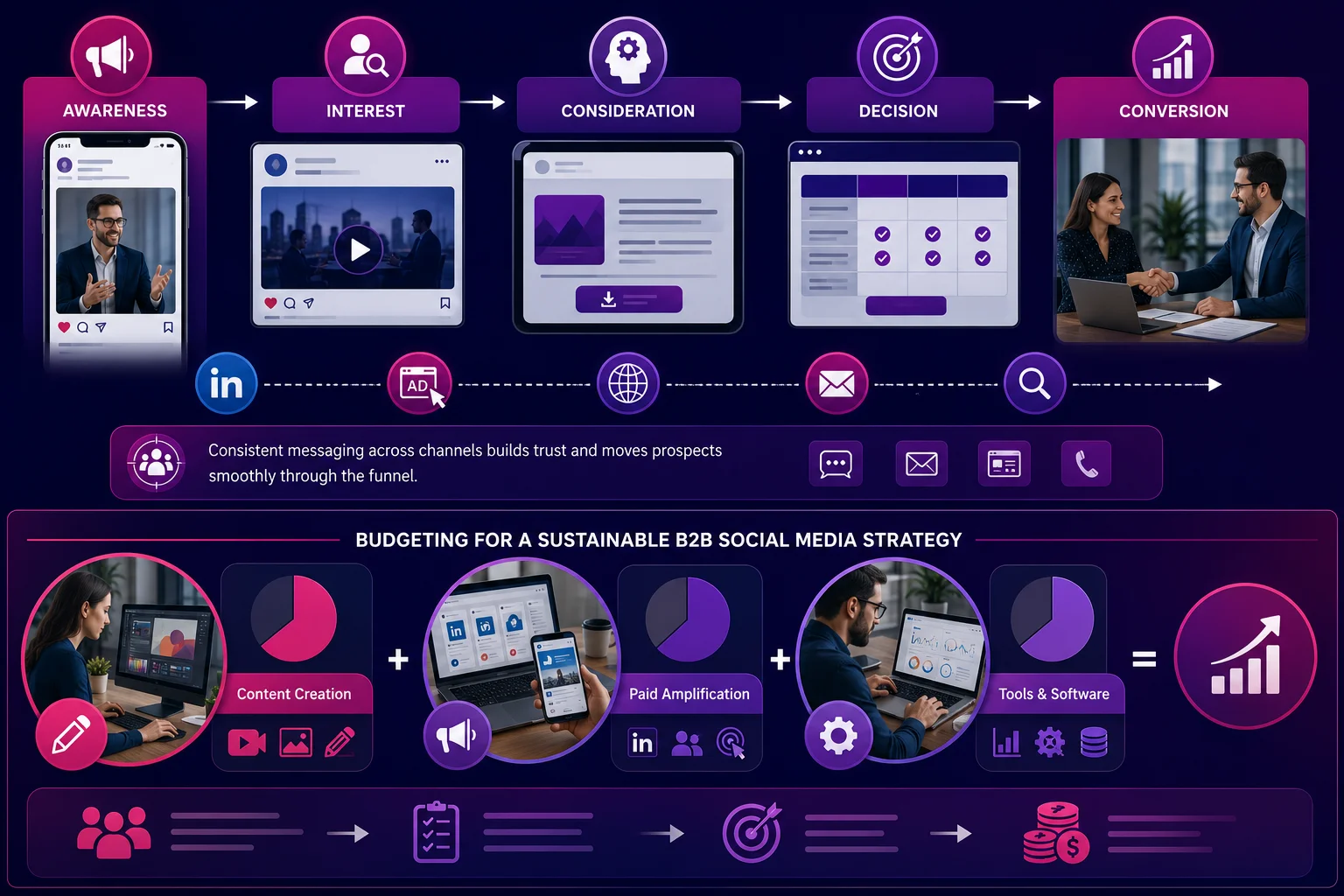
Social media rarely closes a deal on its own, it's one link in a longer chain. A prospect might first notice your brand through a LinkedIn post, then later click a retargeting ad, visit your site, download a resource, and finally book a call weeks or months later. Treating social as an isolated channel, disconnected from email, paid search, and your website, is one of the most common reasons a b2b marketing social media strategy underdelivers.
The fix is to map out your funnel end to end and make sure every stage hands off cleanly to the next. Top-of-funnel social content should drive people to something useful, a guide, a tool, or a newsletter signup, rather than a hard "book a demo" ask that most cold prospects aren't ready for. Mid-funnel content, like case studies and comparison posts, should feed people toward a clear next step, whether that's a resource, a consultation, or a product trial.
This is also where coordinated campaigns pay off. Running a Digital Marketing push that combines organic social, paid social, and search ensures a prospect sees consistent messaging no matter where they encounter your brand, which shortens the trust-building period that B2B deals usually require.
Budgeting for a Sustainable B2B Social Media Strategy
One of the most common questions marketing leaders ask is how much to actually invest in social media relative to other channels. There's no universal number, but a useful starting framework is to split budget across three buckets: content creation (design, video, writing), paid amplification, and tools or software. Many B2B teams underspend on the first bucket, assuming social content is "free" to produce, then wonder why their organic results are flat compared to competitors investing in stronger creative.
A realistic starting point for a mid-size B2B company is to dedicate the equivalent of one part-time role, whether in-house or outsourced, purely to social content and community management, with a modest paid budget layered on top once organic posts start showing traction. Scaling spend before you know what resonates usually wastes money faster than it builds pipeline.
Common Mistakes That Sink B2B Social Media Efforts
- Posting only company announcements with no educational or human content.
- Ignoring comments and DMs, which kills algorithmic reach and buyer trust alike.
- Copying B2C tactics, memes and trends that don't match a professional buying audience.
- Treating social as a one-off campaign instead of an always-on channel.
- Never repurposing content, leading to burnout and inconsistent posting.
Future Trends Shaping B2B Social Media Marketing
Looking ahead, a few shifts are worth planning for. Short-form video is creeping into B2B feeds as platforms push it algorithmically, meaning even complex, technical offerings will need bite-sized visual explainers, not just long articles. AI-assisted content tools are making production faster, but audiences are also getting better at spotting generic, unedited AI output, so the brands that combine efficient tools with genuine human review and real expertise will pull ahead of those publishing at scale without oversight.
Private communities, LinkedIn groups, niche Slack or Discord communities, and gated newsletters, are also becoming more valuable as public feeds get noisier and algorithms grow less predictable. Investing early in an owned audience, rather than renting attention entirely from platforms you don't control, is likely to be one of the more durable b2b marketing strategies on social media over the next few years.
Putting It All Together
A results-driven b2b marketing strategies on social media approach isn't complicated, but it does require discipline: know your audience, pick the right platforms, lead with value, stay consistent, and measure the metrics that actually reflect pipeline impact. Companies that treat social media as a genuine relationship-building channel, not just another box to check, are the ones converting followers into long-term customers.
If you're not sure where to start, begin small: pick one platform, commit to three posts a week for ninety days, and track engagement from your actual target accounts. That single habit, done consistently, will teach you more about your audience than any amount of theory.
Tools and Tech Stack for Running a B2B Social Media Strategy

Even the best strategy falls apart without the right systems to execute it. Most B2B marketing teams underestimate how much operational overhead social media actually creates, content planning, approvals, design, scheduling, and reporting all need a home, or things slip through the cracks within a few weeks.
Content planning and scheduling
A shared content calendar, whether in a tool like Notion, Airtable, or a dedicated social scheduler, keeps everyone aligned on what's going out and when. Scheduling tools also let you batch a month of content in a single sitting, which is far more sustainable than writing posts the morning they're due.
Design and video production
Not every team has an in-house designer, and that's fine, tools like Canva cover most day-to-day graphics. But for anything meant to explain a product or process, a short, professionally produced Video Animation tends to hold attention far better than a static carousel, especially for complex B2B offerings that are hard to explain in a single image.
Analytics and attribution
Native platform analytics (LinkedIn, X) give you engagement data, but they won't tell you what happened after someone clicked through. Pairing native analytics with your CRM and website analytics closes that loop, so you can trace a closed deal back to the social touchpoints that influenced it, not just the last click before a form fill.
CRM and sales alignment
Social media shouldn't sit in a silo away from sales. When marketing and sales share visibility into which accounts are engaging with content, sales reps can follow up with context instead of cold outreach, a warm comment or profile visit is a far better opener than a generic pitch.
Industry-Specific Approaches to B2B Social Media Marketing
While the core framework stays consistent, execution shifts depending on your industry. A one-size-fits-all approach to b2b social media marketing strategy tends to underperform because different buyers consume content differently.
SaaS and technology companies
Tech buyers respond well to product demos, integration walkthroughs, and comparison content. Short screen-recorded clips showing a feature in action often outperform static screenshots, and founder commentary on industry shifts builds credibility quickly in a fast-moving space.
Professional services and agencies
Trust is everything here. Case studies, client testimonials, and personal thought leadership from partners or senior consultants do more heavy lifting than any paid campaign. Buyers in this category are essentially vetting people, not just a company brand.
Manufacturing and industrial B2B
This sector is often underrepresented on social media, which creates an opportunity. Behind-the-scenes plant footage, process explainers, and sustainability updates perform surprisingly well because so few competitors are posting anything at all. LinkedIn is particularly effective here for reaching procurement managers and engineers.
Financial and B2B fintech companies
Compliance constraints make this category trickier, but educational content, market commentary, regulatory updates, and original data, builds authority without straying into promotional territory that legal teams tend to flag.
How to Build a 90-Day B2B Social Media Rollout Plan
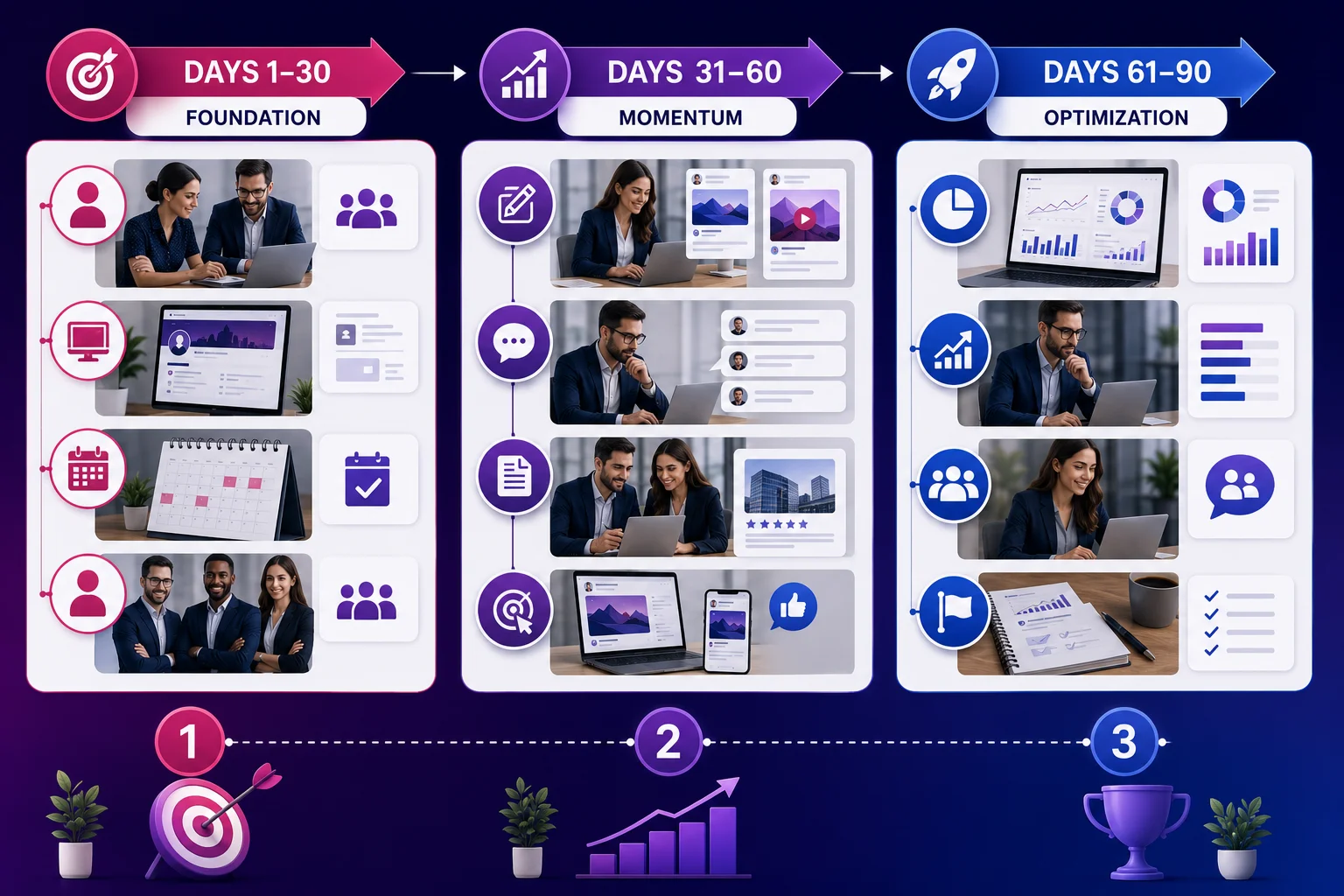
If everything above feels like a lot to implement at once, break it into a simple 90-day rollout instead of trying to do it all in week one.
Days 1–30: Foundation
- Finalize buyer personas and choose your primary platform.
- Audit and optimize your company page, banner, and About section.
- Set up a content calendar and assign clear ownership.
- Identify three to five internal voices who will post as individuals.
Days 31–60: Momentum
- Publish consistently, three to five posts a week on your primary platform.
- Start engaging daily with target-account posts and industry discussions.
- Launch your first case-study or customer-story series.
- Test one or two paid amplification campaigns on top-performing organic posts.
Days 61–90: Optimization
- Review engagement and pipeline data to see which content formats are converting.
- Double down on the two or three formats generating the strongest response.
- Introduce a newsletter or LinkedIn group to build a more owned community.
- Set benchmarks for the next quarter based on what you've learned.
By the end of this cycle, you'll have real data instead of assumptions, which content resonates, which platforms deserve more investment, and where your b2b social media marketing strategies should evolve next.
1. What is the best social media platform for B2B marketing?
LinkedIn is generally the strongest platform for B2B companies because it has the highest concentration of decision-makers and professional context. X (Twitter) works well for industry commentary and PR, while YouTube is valuable for in-depth product education.
2. How often should a B2B company post on social media?
Three to five high-quality posts a week per platform is a realistic, sustainable cadence. Consistency matters far more than volume, a steady schedule builds algorithmic trust over time.
3. Is paid social media advertising worth it for B2B companies?
Yes, especially to amplify content that's already performing organically. Paid social works best as a complement to organic content and search efforts like [Google Ads](https://www.techwithmoonshot.com/services/google-ads) rather than a replacement for either.
4. How long does it take to see results from B2B social media marketing?
Most B2B companies start seeing meaningful engagement and inbound interest within three to six months of consistent posting. Because B2B sales cycles are longer, pipeline impact often takes even longer to fully show up in revenue numbers.
5. Should employees post on behalf of the company?
Yes. Personal profiles, especially from leadership and sales teams, typically get significantly more organic reach than company pages. An employee advocacy program is one of the most cost-effective ways to extend reach.
6. What type of content performs best for B2B audiences?
Educational content, original data, and customer case studies consistently outperform purely promotional posts. Buyers respond to proof and practical insight far more than polished advertising.
7. How is B2B social media strategy different from B2C?
B2B strategy focuses on longer sales cycles, multiple decision-makers, and trust-building content, while B2C strategy tends to prioritize emotional appeal and faster, individual purchase decisions.
8. What metrics matter most for measuring B2B social media success?
Engagement from target accounts, website clicks, inbound messages, and pipeline influenced by social touchpoints matter far more than raw follower counts or likes.
9. Should small B2B companies invest in social media, or is it only for large brands?
Smaller B2B companies often benefit the most, since consistent, genuine content lets them compete for attention without the ad budgets of larger competitors. A founder posting honestly about their journey can outperform a big brand's polished but generic content.
10. How do I get my sales team to support the social media strategy?
Involve them early, ask what questions prospects actually ask, and turn those into content. Sales teams are far more likely to share and engage with posts that reflect real conversations they're having, which also extends organic reach through their own networks.
For more questions?
Contact Us