

Every marketer has stared at a blank content calendar wondering what to post next. It happens to solo creators, in-house teams, and full-service agencies alike, the platforms keep changing, audience attention keeps shrinking, and yesterday's winning format can stop working almost overnight. That's exactly why having a reliable well of social media marketing ideas matters so much heading into 2026. It's not about chasing every trend; it's about having a repeatable system for generating fresh, relevant content week after week.
This guide is built for two audiences at once: brands managing their own accounts and the teams behind a digital marketing agency social media content ideas 2026 strategy who need to keep multiple client calendars stocked with fresh angles. We'll walk through proven frameworks, platform-specific formats, and a full year's worth of marketing ideas for social media that go well beyond generic "post more Reels" advice.
By the end, you'll have a practical, organized library of social media marketing content ideas you can plug directly into a content calendar, along with the strategic thinking behind why each idea works, so you're never staring at a blank page again.
Why Content Ideas Run Dry, and How to Fix It for Good

Most accounts don't fail because they lack creativity. They fail because they rely on inspiration instead of a system. Waiting for a great idea to strike is a slow, unreliable way to fill a calendar that needs multiple posts a week, every week, indefinitely. The accounts that never seem to run out of social media marketing ideas are almost always working from a structured framework of repeatable content pillars, not a fresh burst of inspiration every single time.
The fix is simple in concept, if not always in execution: build a small set of content pillars, recurring themes your brand can return to again and again, and then generate specific post ideas underneath each one. This turns content planning from a creative struggle into something closer to filling out a template.
The Five-Pillar Content Framework
A strong content mix balances five recurring pillars. Not every post fits neatly into one box, but using this structure as a planning guide keeps your feed varied instead of one-note.
| Pillar | Purpose | Example Format |
|---|---|---|
| Educational | Teach the audience something useful | How-to carousel, tutorial video |
| Entertaining | Build relatability and shareability | Trend audio, meme format, skit |
| Inspirational | Reinforce brand values and vision | Behind-the-scenes story, quote graphic |
| Promotional | Drive direct sales or sign-ups | Product demo, limited-time offer post |
| Community | Build connection and conversation | Polls, Q\&A, user-generated content |
A healthy weekly mix generally leans educational and entertaining, with promotional content making up no more than a fifth of total posts. Audiences tolerate, and even welcome, the occasional sales post when it's surrounded by content that's actually useful or fun on its own.
20 Evergreen Social Media Marketing Ideas That Work in Any Niche
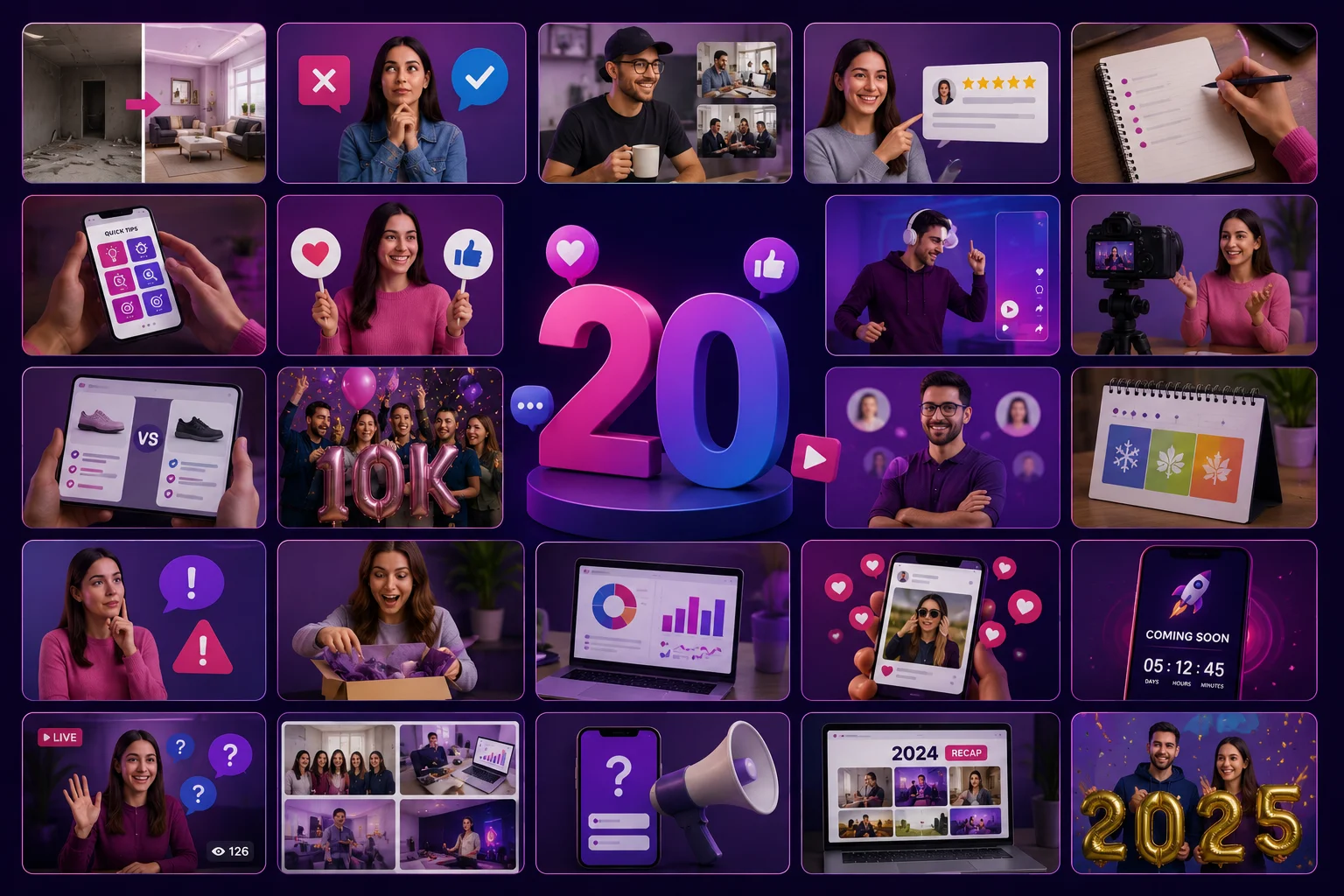
Some formats are close to universal, they work whether you're selling skincare, software, or plumbing services. These are the reliable fallbacks worth keeping in your back pocket whenever the calendar looks thin.
- Before-and-after transformation: Show a real result your product or service produced.
- Myth vs. fact post: Correct a common misconception in your industry.
- Day-in-the-life: Give a behind-the-scenes look at your team or process.
- Customer testimonial spotlight: Feature a real review in an eye-catching graphic or clip.
- "Things I wish I knew" list: Share hard-won lessons relevant to your niche.
- Quick tip carousel: Break one useful tip into 5–7 swipeable slides.
- This or that poll: Ask a simple, low-effort question to boost engagement.
- Trend remix: Apply a trending audio or format to your own niche.
- FAQ answered on camera: Turn a common customer question into a short video.
- Product comparison: Compare two options to help buyers decide.
- Milestone celebration: Mark a company anniversary, follower count, or launch.
- Employee or team spotlight: Humanize the brand by featuring real people.
- Seasonal tie-in: Connect your product to a holiday or season naturally.
- Common mistake breakdown: Explain a mistake your audience often makes.
- Unboxing or first impressions: Capture a genuine first reaction to a product.
- Statistic or data reveal: Share a surprising number relevant to your niche.
- User-generated content repost: Reshare a customer's post with credit and thanks.
- Countdown or launch teaser: Build anticipation before a release.
- "Ask me anything" session: Open the floor for live audience questions.
- Year-in-review recap: Summarize wins, changes, or lessons from the year.
Platform-Specific Content Ideas
General ideas are a great starting point, but the best-performing accounts adapt each concept to the platform it's posted on. Here's how to translate the same core idea across formats.
Instagram and Facebook
Carousels remain one of the strongest formats for saves and shares, especially for educational content broken into digestible slides. Reels drive discovery, while Stories are ideal for polls, countdowns, and quick behind-the-scenes moments that don't need to live permanently on the main feed.
TikTok
Native trends, voiceover storytelling, and fast-paced editing perform best here. TikTok audiences respond especially well to authenticity over polish, so raw, in-the-moment content often outperforms heavily produced videos.
Text-based thought leadership posts, data-driven carousels, and employee spotlights consistently outperform overly promotional content on LinkedIn. This platform rewards insight and professional credibility over flashy visuals.
Idea pins, infographics, and step-by-step visual guides thrive here, particularly in home, food, fashion, and DIY niches where users are actively searching for inspiration rather than passively scrolling.
YouTube Shorts
Shorts work well as teasers for longer content, quick tips, or single-question answers that reward viewers for watching the full long-form video for more depth.
Building a Scalable System for Agencies
Managing one account's content calendar is manageable. Managing content across a dozen clients is a different challenge entirely, which is exactly why digital marketing agency social media content ideas 2026 strategies need to be systemized rather than reinvented for every account from scratch.
Build a Master Idea Bank, Then Customize
Rather than brainstorming from zero for every client, agencies benefit from maintaining a master list of the five-pillar framework above, then tailoring each idea to a specific client's voice, offer, and audience. This turns a blank-page problem into a fill-in-the-blank exercise, dramatically speeding up planning across accounts.
Batch Planning by Pillar, Not by Client
Instead of planning one client's entire month before moving to the next, many agencies find it faster to plan one pillar, say, educational content, across all clients at once, since the creative thinking transfers more easily within a single content type than across an entire calendar.
Track What Actually Performs, Client by Client
A monthly performance review, broken down by pillar and format, quickly reveals which ideas are earning their place in the calendar and which ones should be retired. What performs brilliantly for one client's audience may fall flat for another, so this review needs to happen per account, not just at the agency level.
A Sample Weekly Content Calendar Template
Here's a simple weekly structure that balances all five pillars without overwhelming a small team.
| Day | Pillar | Sample Idea |
|---|---|---|
| Monday | Educational | Quick tip carousel |
| Tuesday | Community | Poll or question sticker |
| Wednesday | Entertaining | Trend remix or behind-the-scenes clip |
| Thursday | Inspirational | Customer story or team spotlight |
| Friday | Promotional | Product feature or limited offer |
A Twelve-Month Idea Bank: Seasonal and Recurring Campaign Themes
Beyond evergreen formats, tying content to the calendar year gives audiences a reason to expect and look forward to certain posts. Building a rough seasonal map ahead of time removes the last-minute scramble that tends to happen around major dates.
| Month | Seasonal Angle | Content Idea |
|---|---|---|
| January | New year, fresh start | Goal-setting tips tied to your product or service |
| February | Appreciation and relationships | Customer or team appreciation spotlight |
| March | Spring refresh | Spring cleaning or refresh-themed tips |
| April | Renewal and growth | Behind-the-scenes growth story or milestone |
| May | Preparation season | Early access or pre-launch teaser content |
| June | Midyear check-in | Midyear results recap or progress update |
| July | Summer engagement | Light, fun, community-driven content |
| August | Back-to-routine | Practical tips as audiences return to normal routines |
| September | Planning ahead | Educational deep-dive or how-to series |
| October | Storytelling season | Customer story or transformation feature |
| November | Gratitude and offers | Appreciation post paired with a seasonal offer |
| December | Reflection and celebration | Year-in-review recap and highlights |
None of these ideas need to be treated as rigid rules, they're simply a starting scaffold that keeps a calendar feeling timely without requiring a completely new idea every single week.
Getting More Mileage Out of Every Idea: A Repurposing Framework
One of the most overlooked efficiency gains in content planning is simple: a single strong idea rarely needs to exist as only one post. A single customer testimonial, for example, can become a quote graphic, a short video clip, a caption-led story post, and a slide inside a broader carousel, four pieces of content from one original idea.
The One-to-Many Approach
Start with the format that takes the most effort to produce, usually video, and work backward. A single filmed segment can be trimmed into a short-form clip, transcribed into a text-based caption post, and screenshotted into a quote graphic, multiplying the return on the original time investment.
The Evergreen Refresh
Older posts that performed well are worth revisiting every few months with a small update, a new example, a refreshed graphic, or a current statistic, rather than assuming a topic is permanently "used up" after its first appearance.
Finding a Content Voice That Doesn't Sound Like Everyone Else
Two brands can post the exact same idea and get completely different results, and voice is usually the reason why. A distinct tone, whether that's playful, blunt, warm, or matter-of-fact, gives even a common idea, like a customer testimonial or a quick tip, a reason to stand out in a feed full of similar content.
A simple exercise: write three captions for the same idea in three different tones, then read them out loud. The one that sounds most like an actual person your audience would want to follow, not a corporate press release, is usually the right direction.
Collaborations, Partnerships, and Co-Created Content
Partnering with complementary brands, micro-influencers, or even happy customers introduces a fresh audience and a fresh creative angle without requiring an entirely new content idea from scratch. Simple formats, a joint Q\&A, a co-hosted giveaway, or a swapped guest post, tend to outperform expectations because they bring built-in social proof from both sides of the partnership.
For agencies, this is also a useful cross-client idea: two non-competing clients in complementary niches can sometimes be introduced for a joint campaign, giving both accounts fresh content and expanded reach at no extra production cost.
Matching Ideas to Your Production Budget
Not every account has the same resources, and that's fine, plenty of high-performing content requires nothing more than a phone and a bit of planning. The table below breaks down realistic idea categories by production effort, so smaller teams can prioritize accordingly.
| Effort Level | Typical Format | Example Idea |
|---|---|---|
| Low | Phone footage, no editing | Quick tip, poll, behind-the-scenes clip |
| Medium | Basic editing, graphics | Carousel, testimonial graphic, trend remix |
| High | Scripted, produced video | Product demo, brand story, launch campaign |
A healthy calendar usually leans heavily on low- and medium-effort ideas, reserving high-production content for genuinely important moments like a major launch or campaign, rather than trying to produce cinematic content for every single post.
Adapting the Framework by Industry
The five-pillar structure holds up across industries, but the specific ideas underneath it should shift depending on what a business sells and who it's talking to. A few examples make this concrete.
Retail and E-Commerce Brands
Product styling ideas, user-generated unboxing content, and limited-time bundle promotions tend to perform especially well, since visual, purchase-ready content matches how shoppers already browse on social platforms.
Local Service Businesses
Before-and-after project photos, client testimonials, and quick educational tips about common problems the business solves consistently build local trust more effectively than generic promotional posts.
SaaS and B2B Companies
Data-driven insights, customer case studies, and short explainer clips tend to outperform lifestyle-style content, since B2B audiences are typically evaluating credibility and results rather than aesthetics.
Health, Wellness, and Coaching
Myth-busting posts, client transformation stories, and simple educational breakdowns of common misconceptions tend to build authority quickly in a space where trust is the primary purchase driver.
Assigning Ownership Without Overcomplicating the Process
Even a simple content system falls apart without clear ownership. Smaller teams often assign one person to own the content calendar end-to-end, while larger teams or agencies benefit from splitting responsibilities: one person focused on ideation and planning, another on production, and a third on scheduling and performance review.
Whatever the team size, a simple weekly or biweekly check-in, reviewing what's scheduled, what performed well, and what needs to be swapped out, keeps the whole system running smoothly without requiring constant oversight.
Running a Monthly Content Batching Session
Many teams find that a single, focused batching session each month is far more productive than trying to create content in scattered, daily bursts. A typical session might run half a day and follow a simple structure: review the previous month's top performers, select ideas for the coming month from the pillar framework, film or design everything in one sitting, and schedule the entire month before the session ends.
This approach has a compounding benefit beyond just saving time, content created in one sitting tends to feel more consistent in tone and visual style than content created piecemeal over several weeks, which strengthens the overall sense of a cohesive brand presence.
What to Bring to a Batching Session
- A finalized list of ideas pulled from the pillar framework, so no time is wasted brainstorming mid-session.
- Outfits, props, or backdrops prepared in advance if filming multiple looks in one day.
- A rough shot list or caption outline for each piece, even if it's just a few bullet points.
- Last month's performance data to inform which ideas get repeated, refreshed, or retired.
Avoiding Creative Burnout on a Long-Term Basis
Even with a solid system, creating content indefinitely can wear a team down if there's no room for rest or experimentation. Building in an occasional "wildcard" post, something outside the usual pillar structure, purely for creative variety, helps prevent the calendar from feeling like an assembly line.
It also helps to periodically revisit and retire ideas that have quietly stopped performing, rather than continuing to produce them out of habit. A content system should evolve every few months as audience preferences shift, platform algorithms change, and new formats emerge, treating the five-pillar framework as a living structure rather than a fixed rulebook keeps it useful well beyond its first year of use.
The Infrastructure Behind Consistent Content
Great ideas still need solid execution behind them. A well-produced explainer or product demo, the kind of polished Video Animation content that's harder to film on a phone, can turn a simple promotional idea into something genuinely scroll-stopping. For brands running a storefront alongside their content, tying campaigns directly into an E Commerce platform makes it easy to turn a single popular post into a direct, trackable sale rather than just a vanity metric.
A consistent visual identity also matters more than most teams realize. Investing in proper Branding & Identity work, consistent colors, fonts, and tone, makes every post instantly recognizable in a crowded feed, which compounds over time into stronger Brand Awareness than any single viral post could achieve on its own.
Once organic ideas are proven, amplifying the best performers with Google Ads or native platform ads lets a single strong idea reach far beyond your existing followers, while a broader Digital Marketing strategy ties organic content, paid amplification, and email together into one coherent system rather than three disconnected efforts.
For brands that want to capture leads directly from social traffic, a simple landing page or quiz, built with basic Web Development or a lightweight Web Application, often converts far better than sending clicks straight to a generic homepage.
"The brands that never run out of content aren't the most creative ones, they're the most organized ones."
Common Mistakes That Drain a Content Calendar
Posting Without a Clear Goal
Every post should map to at least one pillar and one purpose. Posting just to "stay active" tends to produce forgettable content that neither educates, entertains, nor sells.
Copying Competitors Instead of Adapting Ideas
It's fine to draw inspiration from what's working elsewhere, but directly copying a competitor's exact angle rarely performs as well as adapting the underlying idea to your own brand voice and audience.
Ignoring Performance Data
Teams that never review which pillars or formats are actually converting tend to keep producing content out of habit rather than evidence, wasting effort on formats that quietly stopped working months ago.
Treating Every Platform the Same
Reposting the exact same asset everywhere, with no adjustment for format or audience expectations, is one of the fastest ways to underperform across the board.
Measuring Which Ideas Are Actually Working
Likes and follower counts feel satisfying but rarely tell the full story. When evaluating your library of social media marketing content ideas, track saves, shares, comments, and click-throughs, these signals correlate far more closely with real business impact than raw engagement numbers alone.
| Metric | What It Signals | Best Tracked For |
|---|---|---|
| Saves | Content is useful enough to revisit | Educational posts |
| Shares | Content resonates enough to pass along | Entertaining, inspirational posts |
| Comments | Content sparked genuine conversation | Community posts |
| Click-through rate | Content is driving real intent | Promotional posts |
Reviewing these numbers monthly, rather than obsessing over daily fluctuations, gives a clearer, more reliable picture of which ideas deserve a permanent spot in the rotation.
Conclusion
There's no shortage of ways to fill a content calendar once you stop waiting for inspiration and start working from a system. The five-pillar framework, the evergreen idea list, and the platform-specific adaptations in this guide together form a practical, repeatable well of marketing ideas for social media that any brand or agency can lean on indefinitely. Whether you're managing one account or juggling content across a dozen clients, the goal is the same: turn content planning from a creative scramble into a dependable, organized process, one that keeps producing fresh social media marketing ideas long after the initial inspiration has worn off.
What are the best social media marketing ideas for a small business in 2026?
Customer testimonials, before-and-after content, quick educational tips, and behind-the-scenes posts tend to perform reliably well for small businesses because they build trust without requiring a large production budget.
How often should a brand post on social media?
Most active accounts post between three and seven times per week per platform, prioritizing consistency and quality over sheer volume.
What content ideas work best for a digital marketing agency managing multiple clients?
A master content-pillar framework that's customized per client tends to work best, since it speeds up planning while still allowing each account's content to feel tailored and authentic.
How do I come up with new social media marketing content ideas every week?
Working from a fixed set of content pillars, educational, entertaining, inspirational, promotional, and community, makes idea generation far more systematic than waiting for random bursts of creativity.
Should every social media post include a call to action?
Not necessarily. Educational and entertaining posts often perform better without a hard sell, while promotional posts should almost always include a clear next step.
What's the difference between content ideas for Instagram versus TikTok?
Instagram tends to reward polished carousels and Reels with a consistent aesthetic, while TikTok favors raw, fast-paced, trend-driven content that feels native to the platform.
How do I know which social media marketing ideas are actually working?
Track saves, shares, comments, and click-through rates rather than just likes, since these metrics correlate more closely with real audience value and business impact.
Is it okay to reuse the same content idea across multiple platforms?
The core idea can be reused, but the format and pacing should be adapted to each platform rather than posting the exact same asset everywhere.
For more questions?
Contact Us