
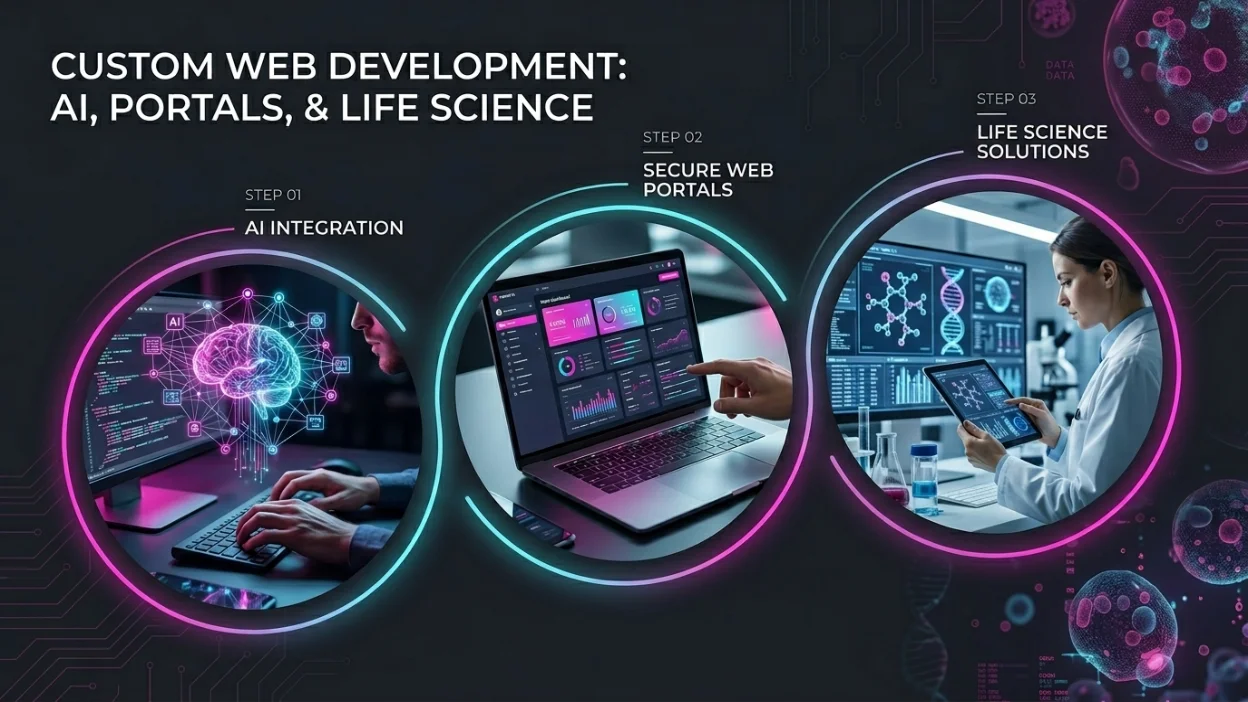
If you're building a digital product for your business in the United States, you already know one thing: off-the-shelf solutions rarely cut it anymore. Whether you need a web portal development service, a platform built for life science web development, or custom web development services with AI integration, the stakes are higher than ever.
This guide walks you through everything, from what custom web development actually means to how you can implement it for your industry. We'll cover use cases, real examples, step-by-step setup, comparisons, pros and cons, and FAQs that real users in the US are asking right now.
Whether you're a startup, an enterprise, or an agency looking to build smarter web applications, this article is your roadmap.
What Is Custom Web Development?
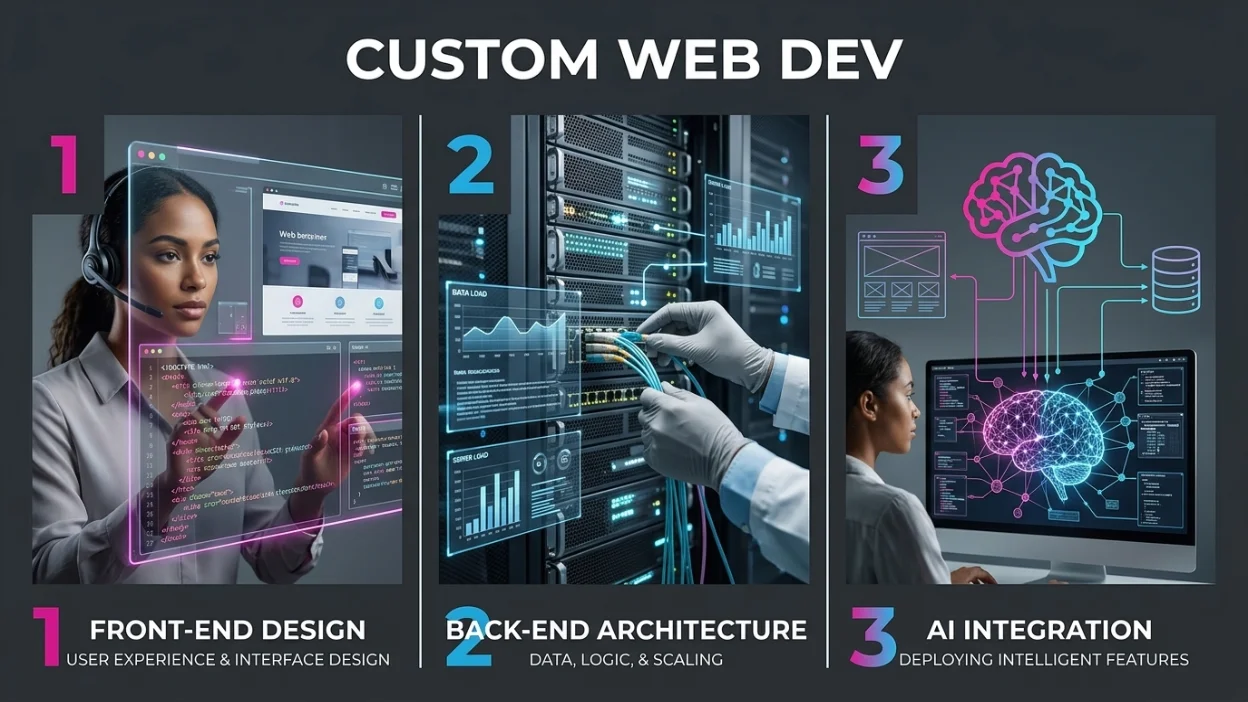
Custom web development is the process of designing, building, and launching websites and web applications that are built specifically for your business goals, not from a generic template or out-of-the-box CMS.
Think of it this way: a WordPress theme gives you a house that hundreds of others live in. Custom web development gives you a house that's built from the ground up, exactly the way you want it.
It covers:
- Front-end development, what users see and interact with
- Back-end development, the server, database, and logic that power your app
- Full-stack development, both combined
- API integration, connecting your platform to other services
- AI-powered features, smart automation, recommendations, and analytics
The demand for custom web development services is growing fast. Google Trends data shows search interest for custom development solutions has risen steadily across the United States, particularly for AI-powered, multilingual, and industry-specific builds.
Custom vs. Standard Web Development: Key Differences
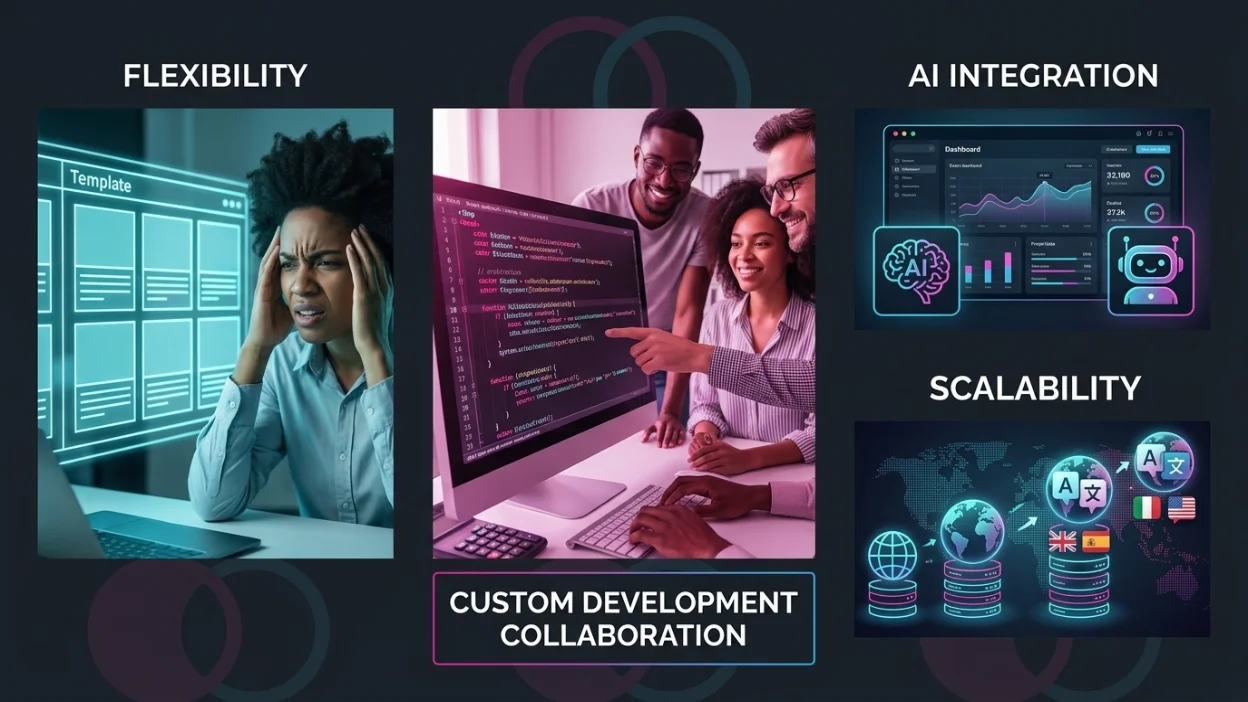
Before you decide, here's a clear comparison to understand what you're choosing between:
| Feature | Standard Web Dev | Custom Web Dev |
|---|---|---|
| Flexibility | Limited to templates | Fully tailored to your needs |
| AI Integration | Rarely available | Built-in with custom workflows |
| Multilingual Support | Plugin-based only | Deep integration possible |
| Scalability | Moderate | Designed for long-term growth |
| Industry-Specific | Generic | Life science, education, portals & more |
| PHP Customization | Basic | Full-stack custom PHP development |
| Cost Over Time | Higher (license fees) | Lower (own your code) |
As you can see, custom web development gives you more control, better long-term value, and the ability to integrate advanced technologies like AI. If your business is scaling, competing at the enterprise level, or working in a regulated industry like life sciences, custom is the clear choice.
Life Science Web Design and Development
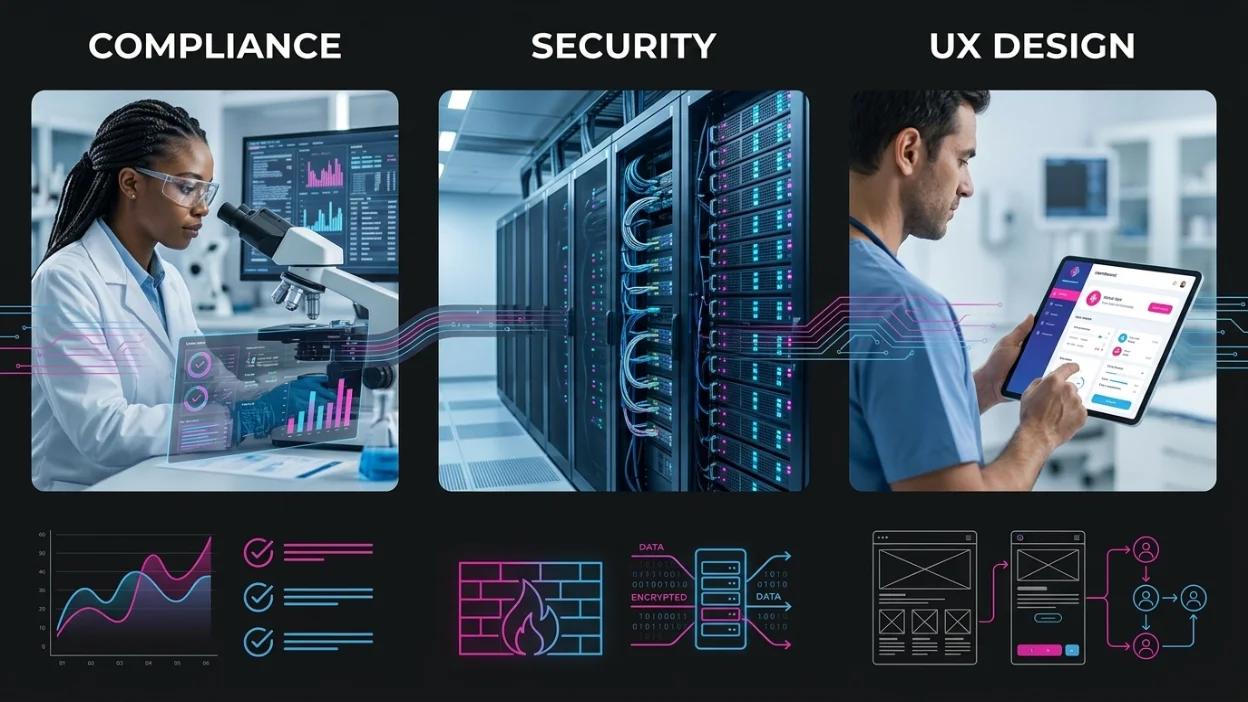
The life science industry is one of the most demanding sectors when it comes to web development. Whether you're a biotech company, pharmaceutical firm, or clinical research organization, your web platform must meet very specific needs.
Why Life Science Web Development Is Different
- Regulatory compliance, HIPAA, FDA 21 CFR Part 11, GDPR
- Data security, sensitive patient and research data must be protected
- Complex user roles, researchers, clinicians, administrators, regulators all need different access
- Integration requirements, EMR systems, laboratory software, reporting tools
- Accessibility standards, Section 508 compliance for US government-funded projects
Great life science web design and development goes beyond making things look good. It means creating a platform that can handle clinical trial management, patient data visualization, research documentation portals, and real-time analytics, all in a secure, compliant environment.
Pairing solid UI UX Design Services with life science expertise is what separates a good platform from a great one. Users in the life science space need intuitive interfaces that reduce training time and eliminate human error.
Use Cases in Life Science Web Development
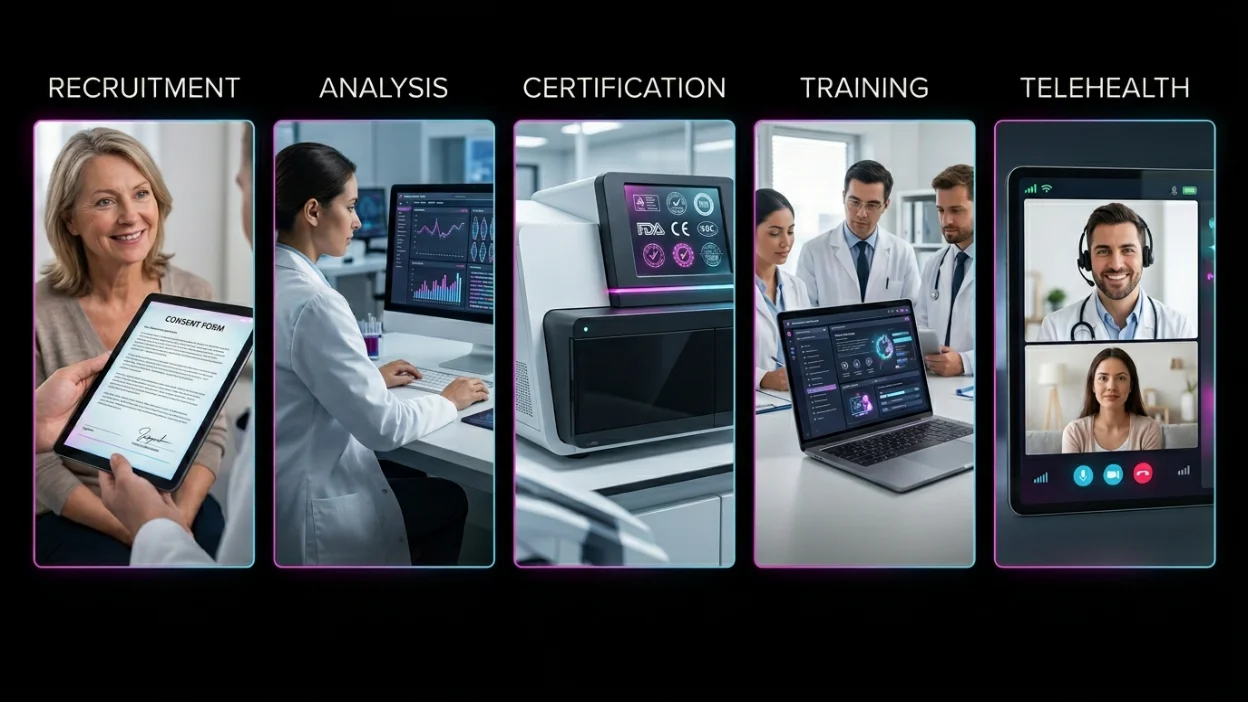
- Clinical Trial Portals, recruit participants, collect consent, track outcomes
- Research Data Management Systems, store, analyze, and report on lab results
- Medical Device Company Websites, product catalogs, certifications, technical documentation
- Pharmaceutical Education Platforms, training modules for staff and healthcare providers
- Patient Engagement Portals, appointment booking, health records, telehealth features
Web Portal Development Services
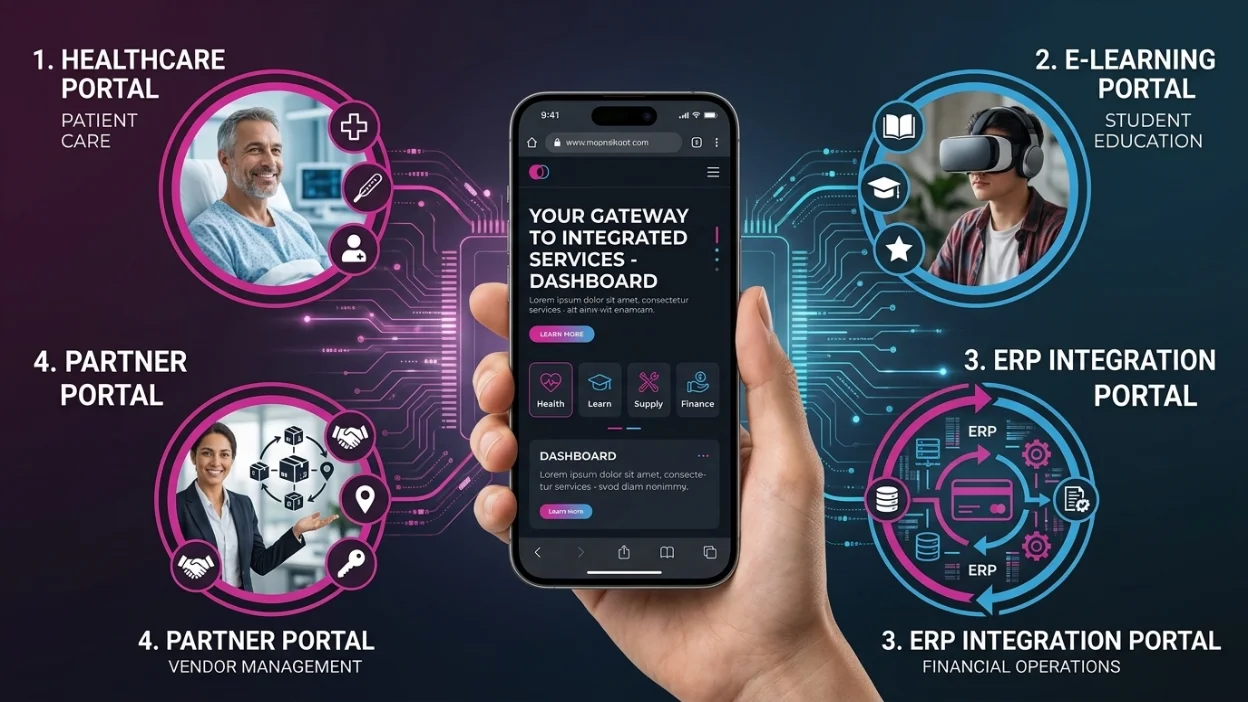
A web portal is not just a website. It's a gateway, a platform that brings together information, tools, and services from multiple sources into one unified experience for specific user groups.
When businesses look for web portal development services, they're typically looking for:
- B2B Portals, for partners, vendors, or distributors
- Customer Self-Service Portals, reduce support costs, improve satisfaction
- Employee Intranets, HR systems, policy documents, collaboration tools
- Healthcare Patient Portals, medical records, prescriptions, appointment scheduling
- E-learning Portals, course management, student tracking, certification
The key to a successful portal is integration. It must connect with your CRM, ERP, payment systems, and third-party APIs. That's where expert Web Development teams come in, they build the architecture that ties everything together.
Key Features of High-Performance Web Portals
- Role-based access control (RBAC)
- Single Sign-On (SSO) and OAuth integration
- Real-time data dashboards
- Document management systems
- Notification systems and workflow automation
- Mobile-responsive design
- Audit logs and compliance tracking
Step-by-Step: How to Set Up a Web Portal
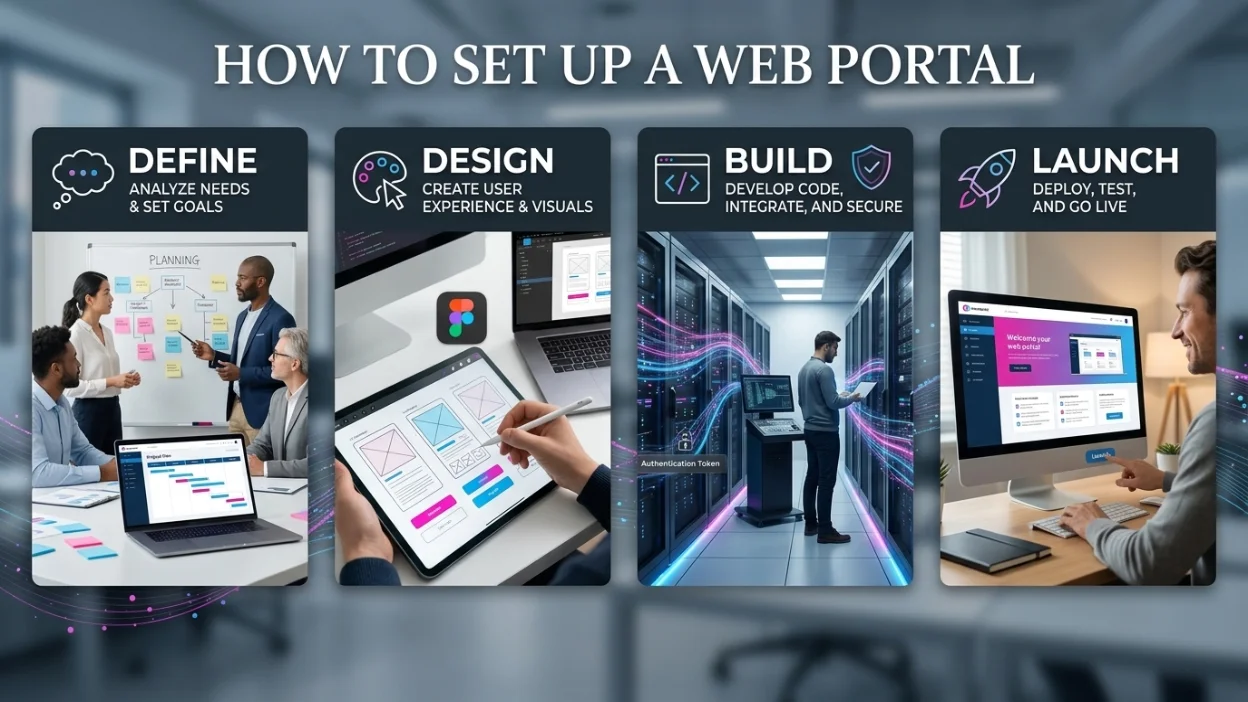
- Define User Roles and Access Levels, who needs access to what?
- Map Out Data Sources, what systems does your portal need to connect with?
- Choose Your Tech Stack, React, Angular, or Vue for front-end; Node.js, Django, or PHP for back-end
- Design the User Interface, prioritize usability and clarity
- Build Authentication Systems, secure login, MFA, and SSO
- Integrate APIs, connect to CRM, ERP, payment gateways
- Test with Real Users, UAT (User Acceptance Testing) is critical
- Launch and Monitor, track usage, errors, and performance
Custom Web Development Services with AI Integration
Artificial intelligence is no longer a future technology. It's being built into websites and web applications right now, and businesses that adopt it early are pulling ahead of those that don't.
Custom web development services with AI integration refers to the process of building web applications that use machine learning, natural language processing (NLP), computer vision, or predictive analytics as part of their core functionality.
What AI Can Do Inside Your Web Application
- Smart Search, AI understands user intent, not just keywords
- Recommendation Engines, like Netflix or Amazon's 'you might also like'
- AI Chatbots, handle customer support at scale, 24/7
- Predictive Analytics, forecast trends and user behavior
- Content Personalization, show each user the most relevant content
- Automated Data Processing, extract, transform, and analyze large datasets
- Fraud Detection, flag suspicious activity in real time
Adding AI features to your platform is one of the most powerful Web Applications enhancements available today. When combined with solid Digital Marketing strategies, AI-powered platforms dramatically improve conversion and retention.
Future of AI in Web Development
Google Trends shows rising search interest in AI-integrated web solutions across the US. Looking ahead, we expect to see:
- Generative AI tools embedded into content management systems
- AI-driven A/B testing and automatic layout optimization
- Voice interface integration across web portals and e-commerce
- Autonomous AI agents that perform multi-step workflows on behalf of users
- Real-time translation and multilingual content generation
Web Development Company for Multilingual Websites
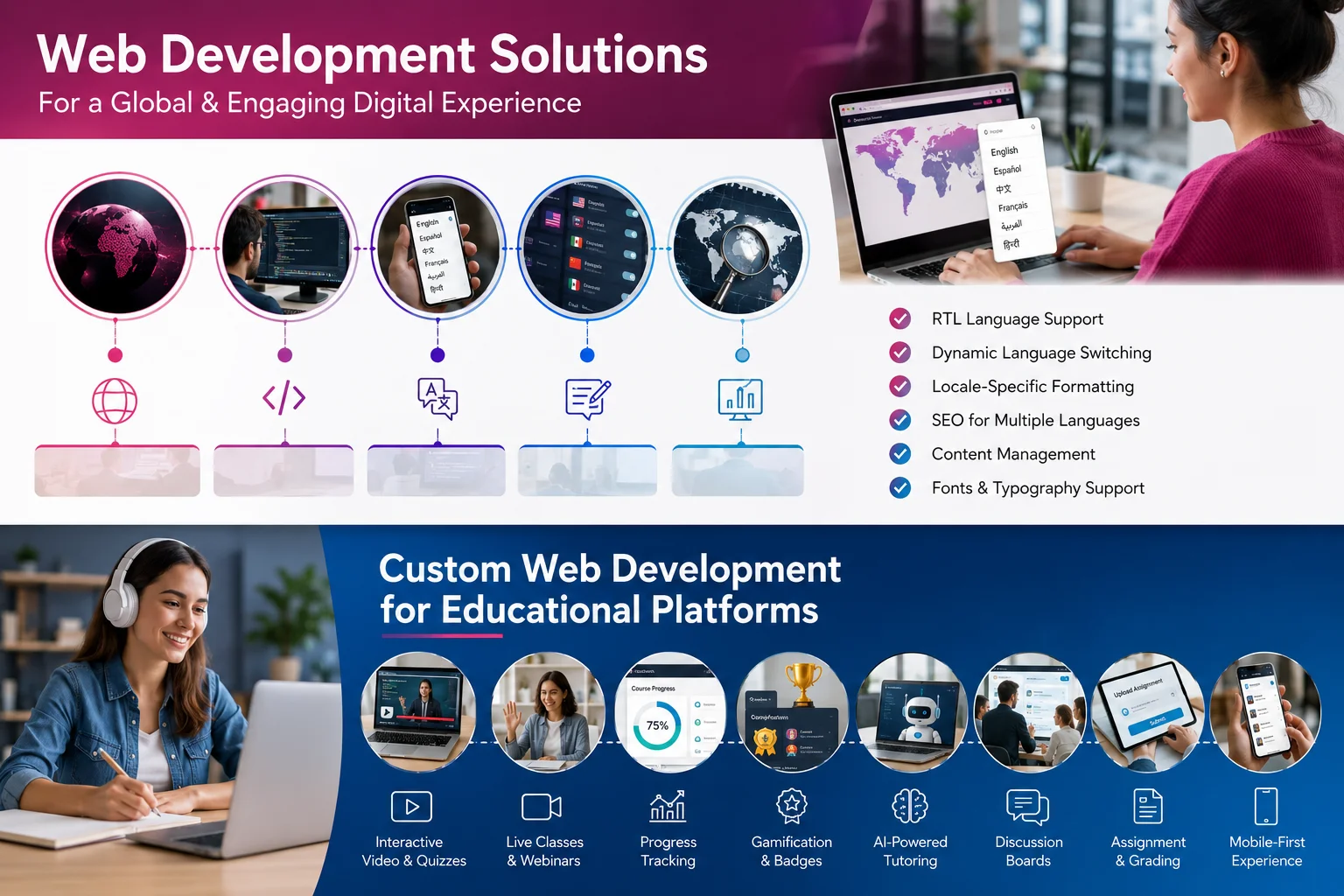
The United States is a multilingual country. Spanish, Chinese, French, and dozens of other languages are spoken by millions of Americans. If your website only serves English speakers, you're leaving revenue on the table.
A web development company for multilingual websites builds platforms that support multiple languages, not through simple translation plugins, but through deep internationalization (i18n) and localization (l10n) architecture.
What True Multilingual Web Development Includes
- RTL Language Support, Arabic, Hebrew, Urdu and others require right-to-left layouts
- Dynamic Language Switching, users can switch languages without page reload
- Locale-Specific Formatting, dates, currencies, phone numbers formatted correctly by region
- SEO for Multiple Languages, hreflang tags, multilingual sitemaps, language-specific URLs
- Content Management, editors can manage translations from one dashboard
- Fonts and Typography, different languages may need different typefaces
This is where great Branding meets technical expertise. Your multilingual site should feel native in every language, not like a translated copy.
Custom Web Development Services for Educational Platforms with Interactive Features
The e-learning market in the United States is massive and growing. Custom web development for educational platforms goes far beyond putting videos online. Today's learners expect interactive, personalized, and engaging experiences.
Must-Have Features in Educational Web Platforms
- Interactive Video Players, with quizzes, branching scenarios, and annotations
- Live Class and Webinar Integration, Zoom, Google Meet, or custom video streaming
- Progress Tracking, learners see how far they've come
- Gamification, badges, leaderboards, and completion certificates
- AI-Powered Tutoring, adaptive learning that adjusts to each student's level
- Discussion Boards, community-driven learning environments
- Assignment Submission and Grading, automated and manual grading tools
- Mobile-First Design, over 60% of learners access courses on mobile devices
Connecting strong Animations and interactive design with solid back-end architecture is what makes educational platforms shine. When combined with smart Mobile Applications development, you can deliver a seamless cross-device learning experience.
Research Tools for Visual Feedback in Web Development Projects
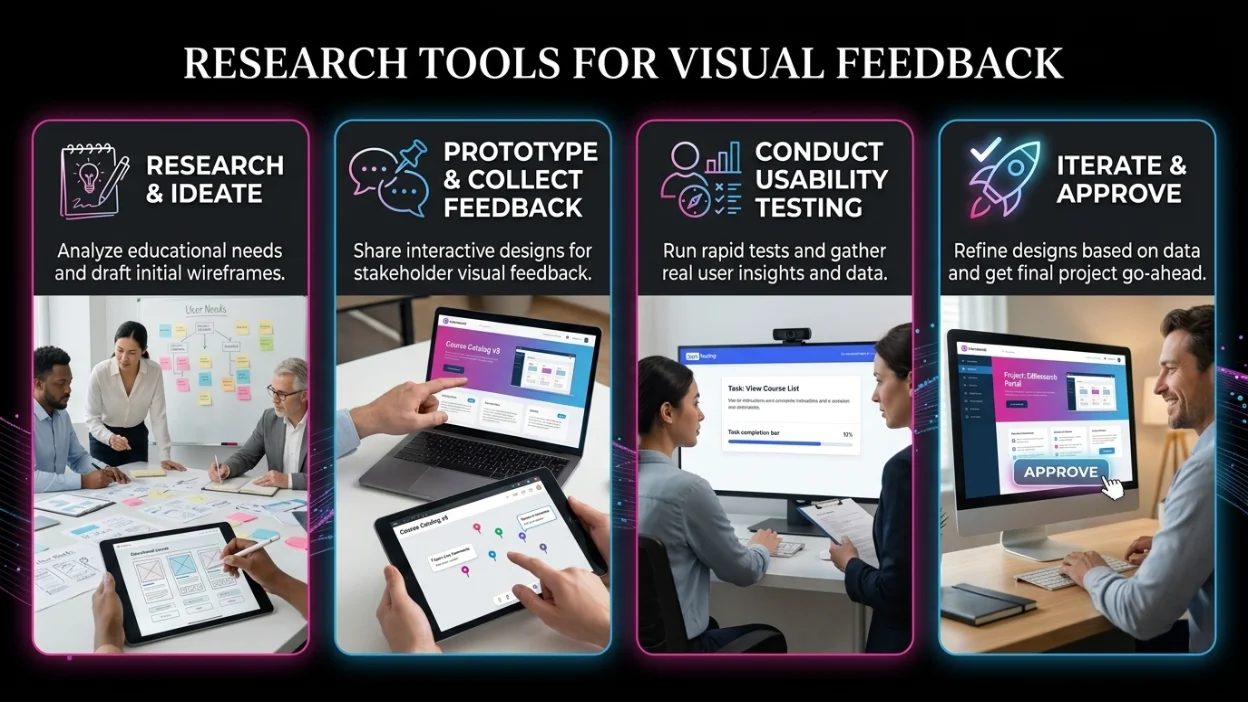
For teams building educational and research platforms, visual feedback tools are essential. These tools help stakeholders annotate, comment on, and approve designs before development begins.
- Figma, collaborative design with live commenting
- InVision, interactive prototypes with feedback threads
- Hotjar, heatmaps and session recordings for UX research
- UserTesting, real user feedback on prototypes
- Maze, rapid usability testing and analytics
Custom PHP Web Development
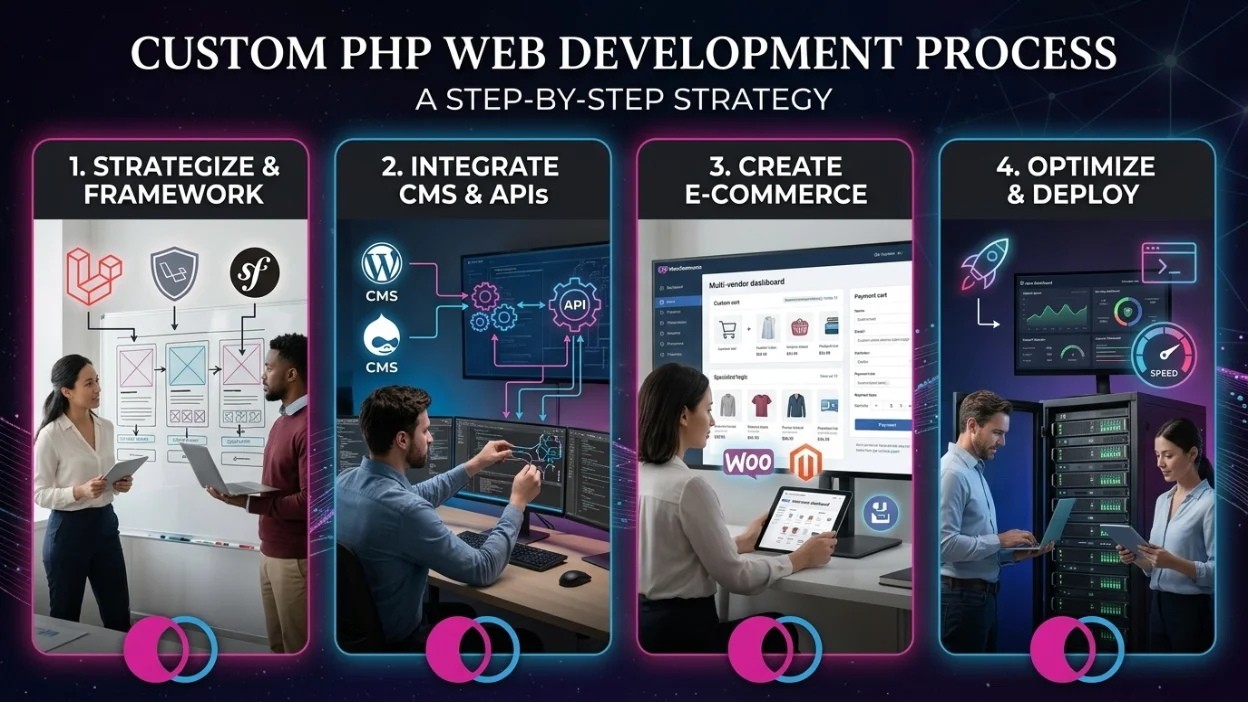
PHP powers more than 77% of all websites on the internet. Despite newer alternatives, custom PHP web development remains one of the most reliable, cost-effective, and scalable approaches to building web applications, especially when customized for specific business logic.
Why Businesses Still Choose Custom PHP
- Mature Ecosystem, Laravel, Symfony, CodeIgniter, and more
- Hosting Flexibility, runs on virtually any server environment
- Cost-Effective, wide pool of experienced PHP developers in the US
- E-Commerce Ready, WooCommerce, Magento, custom cart solutions
- CMS Integration, WordPress, Drupal, Joomla custom development
- API Development, RESTful APIs, GraphQL, SOAP web services
Custom PHP development also pairs well with E-Commerce platform needs. If you're building a complex online store with custom pricing rules, multi-vendor support, or ERP integration, PHP gives you the flexibility to build exactly what you need.
PHP vs. Modern Alternatives
| Technology | Best For | Learning Curve | US Market Share |
|---|---|---|---|
| PHP (Laravel) | Business logic, CMS, e-commerce | Moderate | Very High |
| Node.js | Real-time apps, APIs | Moderate | High |
| Python (Django) | AI/ML apps, data-heavy | Moderate | High |
| Ruby on Rails | Rapid prototyping | Low | Moderate |
Design Force Web Development
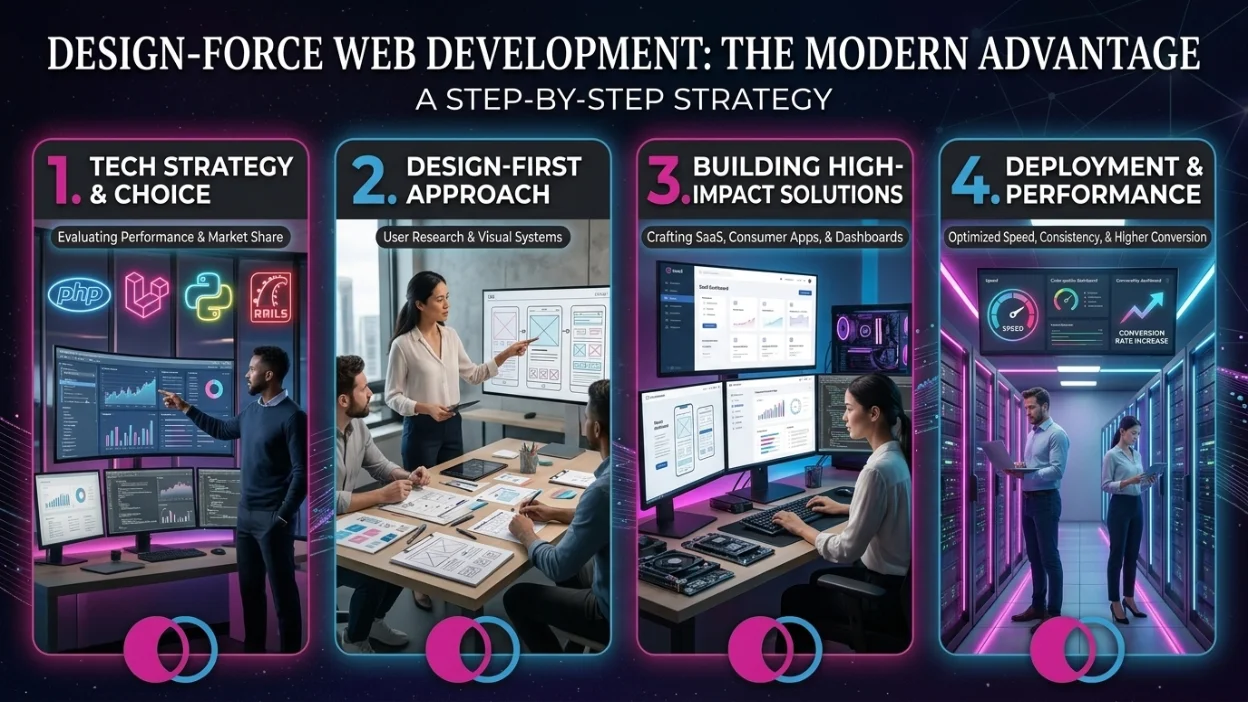
Design-force web development is an approach that puts design at the core of every technical decision. Instead of building first and designing later, design-force teams use user research, prototyping, and visual systems to lead the entire development process.
This methodology is especially valuable for:
- SaaS products that need to differentiate on experience
- Consumer apps where retention depends on delight
- Enterprise dashboards where clarity reduces errors
- Marketing websites where design drives conversion
Strong UI UX Design Services are the backbone of design-force web development. When your design system is solid, developers work faster, make fewer mistakes, and produce more consistent results.
BeeScript Web Application Development
BeeScript web application development refers to a structured, modular approach to building web applications using component-based architecture. Think of it like building with LEGO, each piece is independently designed, tested, and reusable across your entire application.
- Component Reusability, write once, use everywhere
- Separation of Concerns, design, logic, and data are handled independently
- Testability, each module can be unit-tested in isolation
- Scalability, add new features without breaking existing ones
Pros and Cons of Custom Web Development
| ✅ Pros | ❌ Cons |
|---|---|
| Full control over features and functionality | Higher upfront development cost |
| Built-in AI integration for smart automation | Longer time to launch |
| Scales with business growth | Requires experienced development team |
| Better security and data protection | Ongoing maintenance responsibility |
| Optimized performance and speed | Needs thorough planning before start |
| Custom UI/UX aligned with your brand |
How to Implement Custom Web Development: Step-by-Step Guide
Phase 1: Discovery and Planning
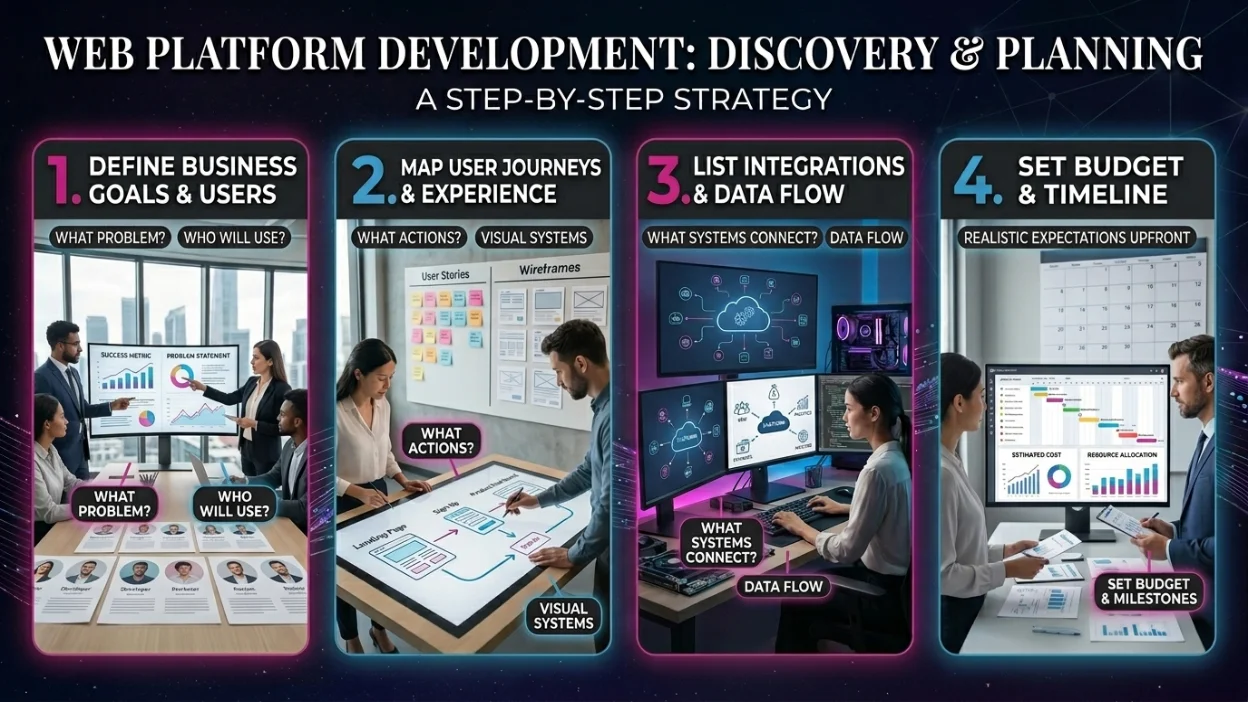
- Define Your Business Goals, what problem is this solving?
- Identify Your Target Users, who will use this platform?
- Map User Journeys, what actions will users take?
- List Integrations, what systems must it connect with?
- Set Budget and Timeline, realistic expectations upfront
Phase 2: Design
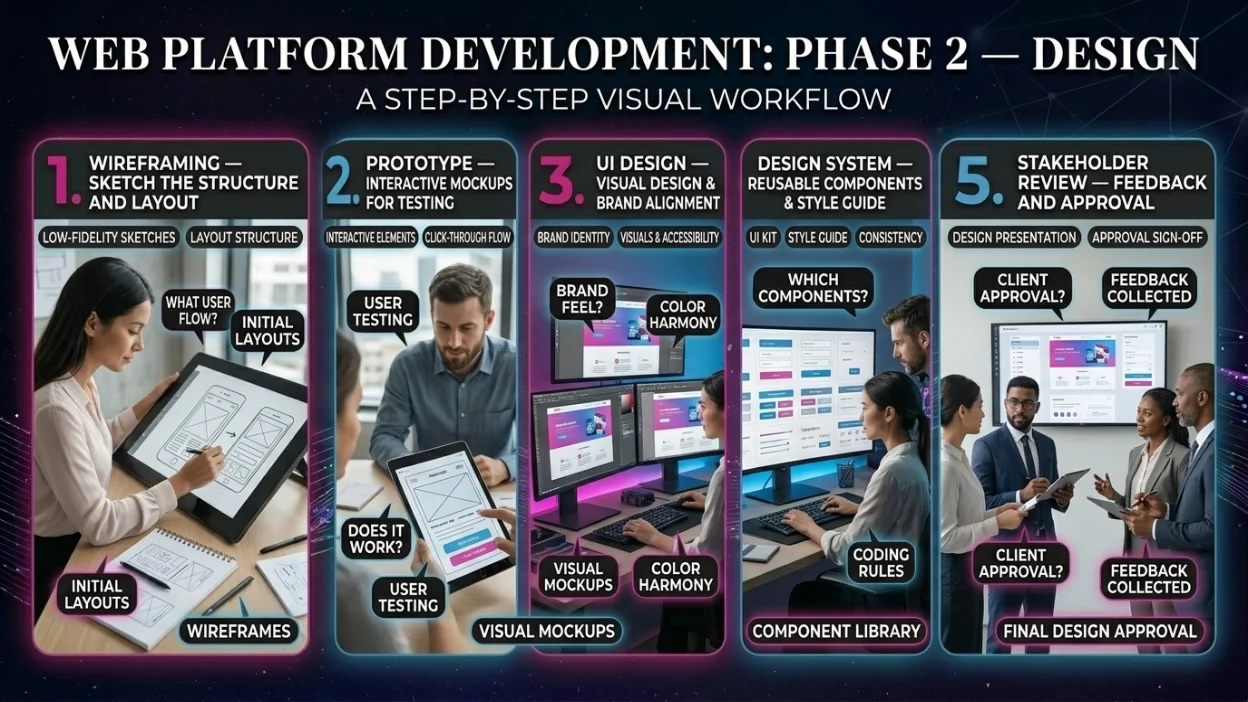
- Wireframing, sketch the structure and layout
- Prototype, interactive mockups for testing
- UI Design, visual design, brand alignment, accessibility
- Design System, reusable components and style guide
- Stakeholder Review, visual feedback and approval
Phase 3: Development
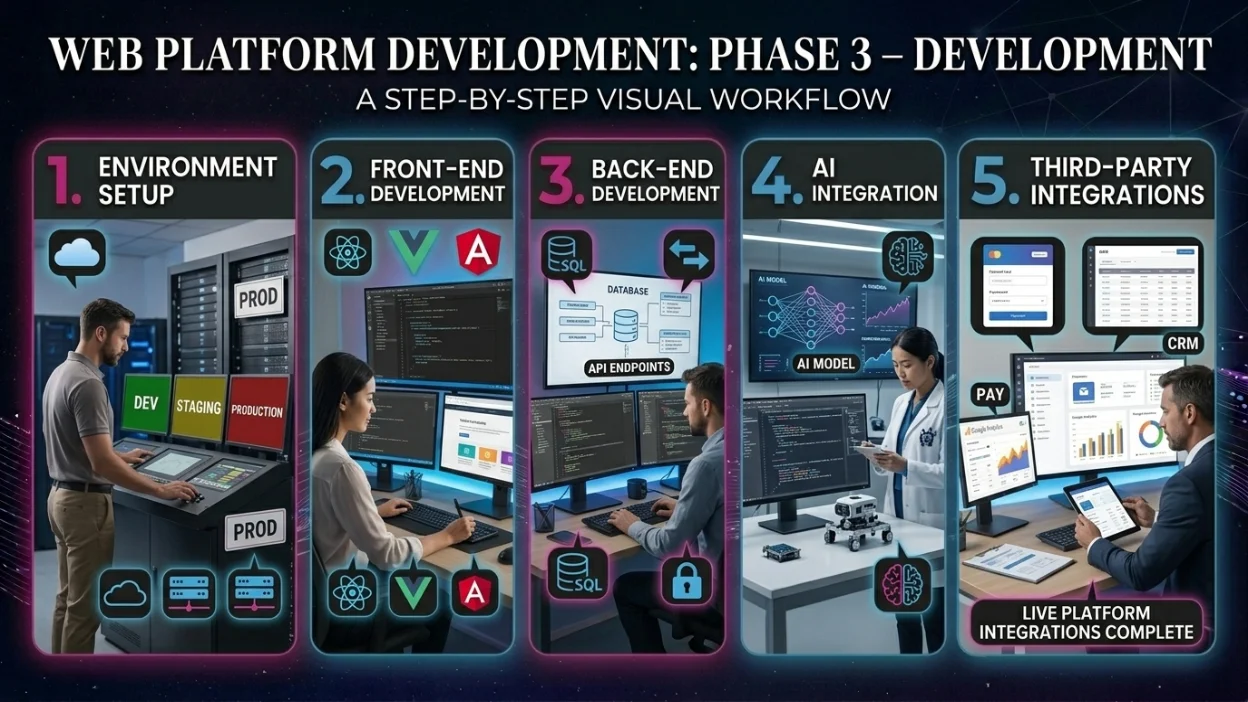
- Environment Setup, dev, staging, and production servers
- Front-End Development, React, Vue, Angular, or vanilla JS
- Back-End Development, APIs, database schema, authentication
- AI Integration, implement AI models or connect to AI APIs
- Third-Party Integrations, payments, analytics, CRMs
Phase 4: Testing
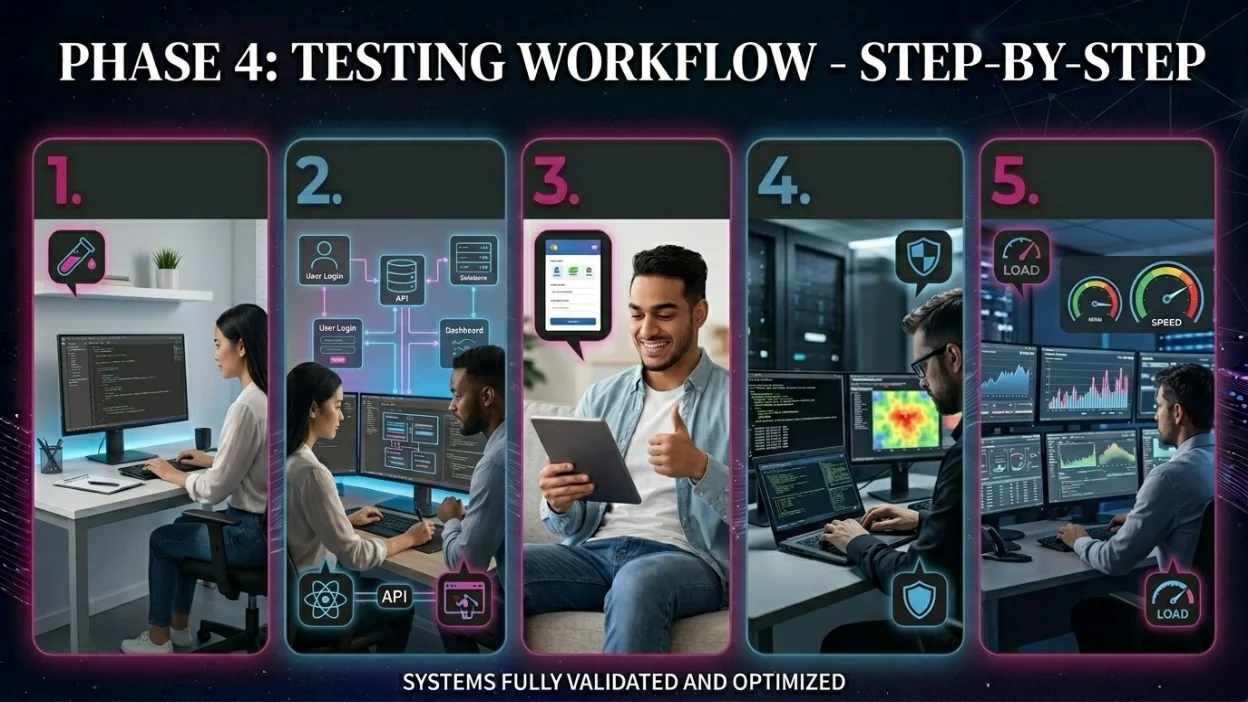
- Unit Testing, each component tested individually
- Integration Testing, systems tested together
- User Acceptance Testing, real users validate the experience
- Security Audit, penetration testing, vulnerability scanning
- Performance Testing, load testing, speed optimization
Phase 5: Launch and Growth
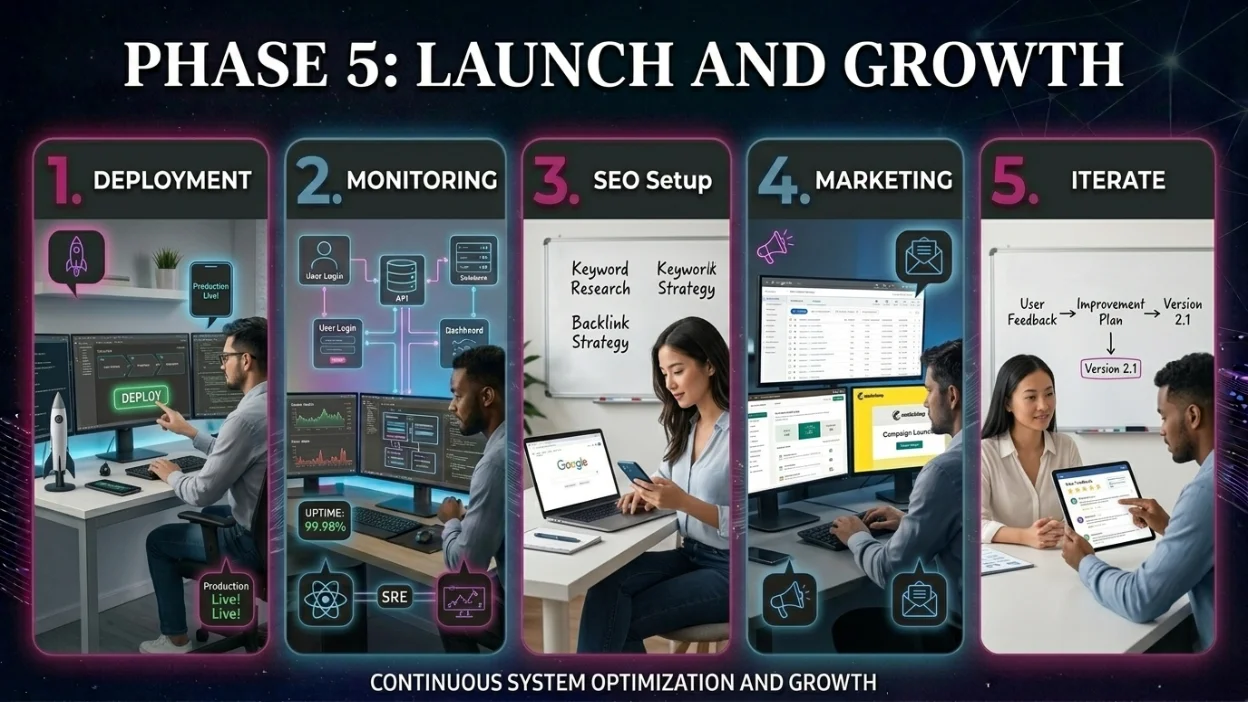
- Deployment, launch to production
- Monitoring, set up error tracking, analytics, uptime monitoring
- SEO Setup, connect with SEO services for visibility
- Marketing, activate Google Ads and Email Marketing to drive traffic
- Iterate, gather user feedback and improve continuously
Data and Statistics: The US Custom Web Development Market
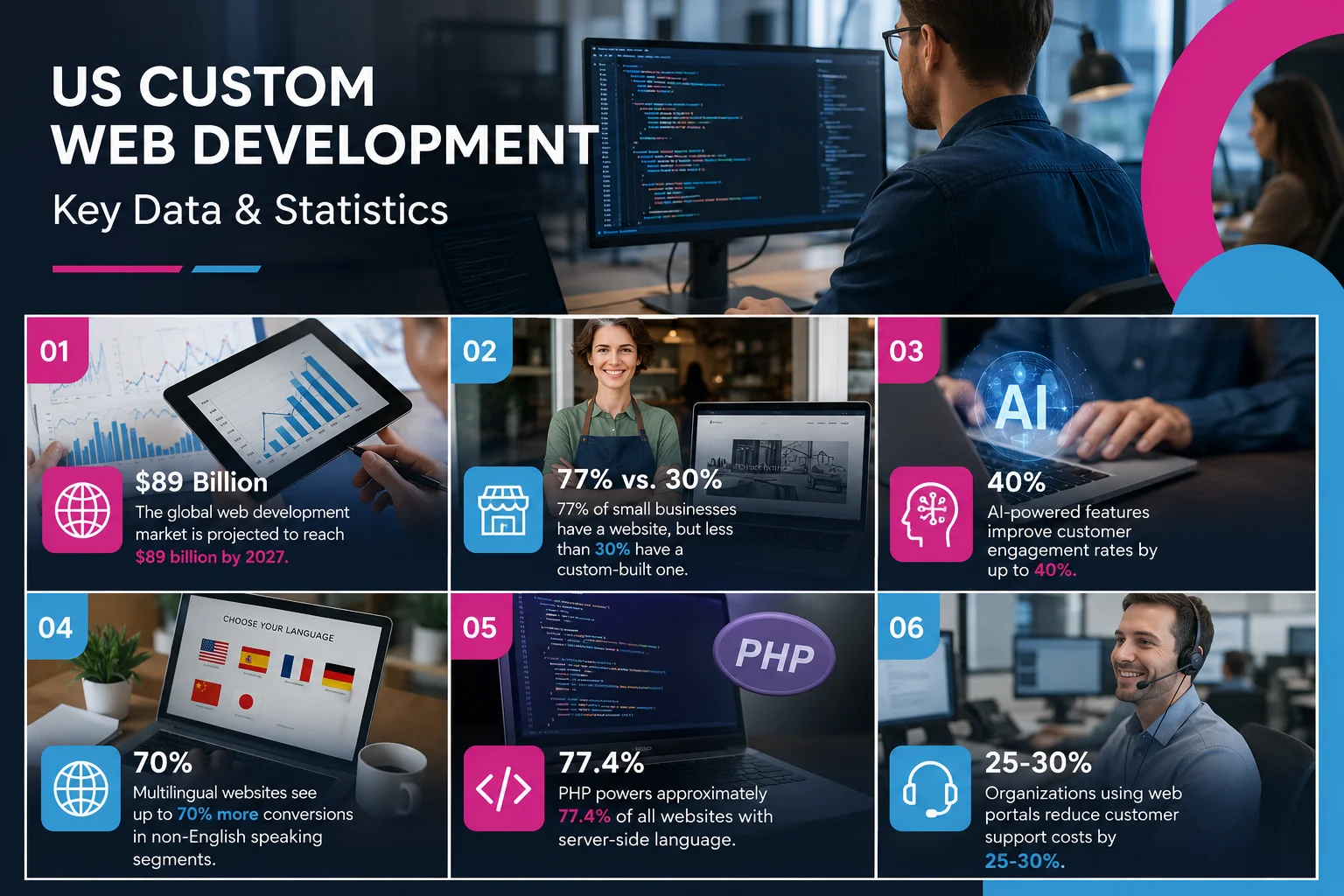
- The global web development market is projected to reach $89 billion by 2027 (Statista)
- 77% of small businesses have a website, but less than 30% have a custom-built one (Forbes)
- AI-powered features improve customer engagement rates by up to 40% (McKinsey)
- Multilingual websites see up to 70% more conversions in non-English speaking segments (CSA Research)
- PHP powers approximately 77.4% of all websites with server-side language (W3Techs)
- Organizations using web portals reduce customer support costs by 25-30% (Gartner)
Note: Always validate current statistics with your industry reports, as figures evolve. Google Trends confirms growing US-based search interest in custom web development, AI integration, and multilingual platforms throughout recent years.
Key Points
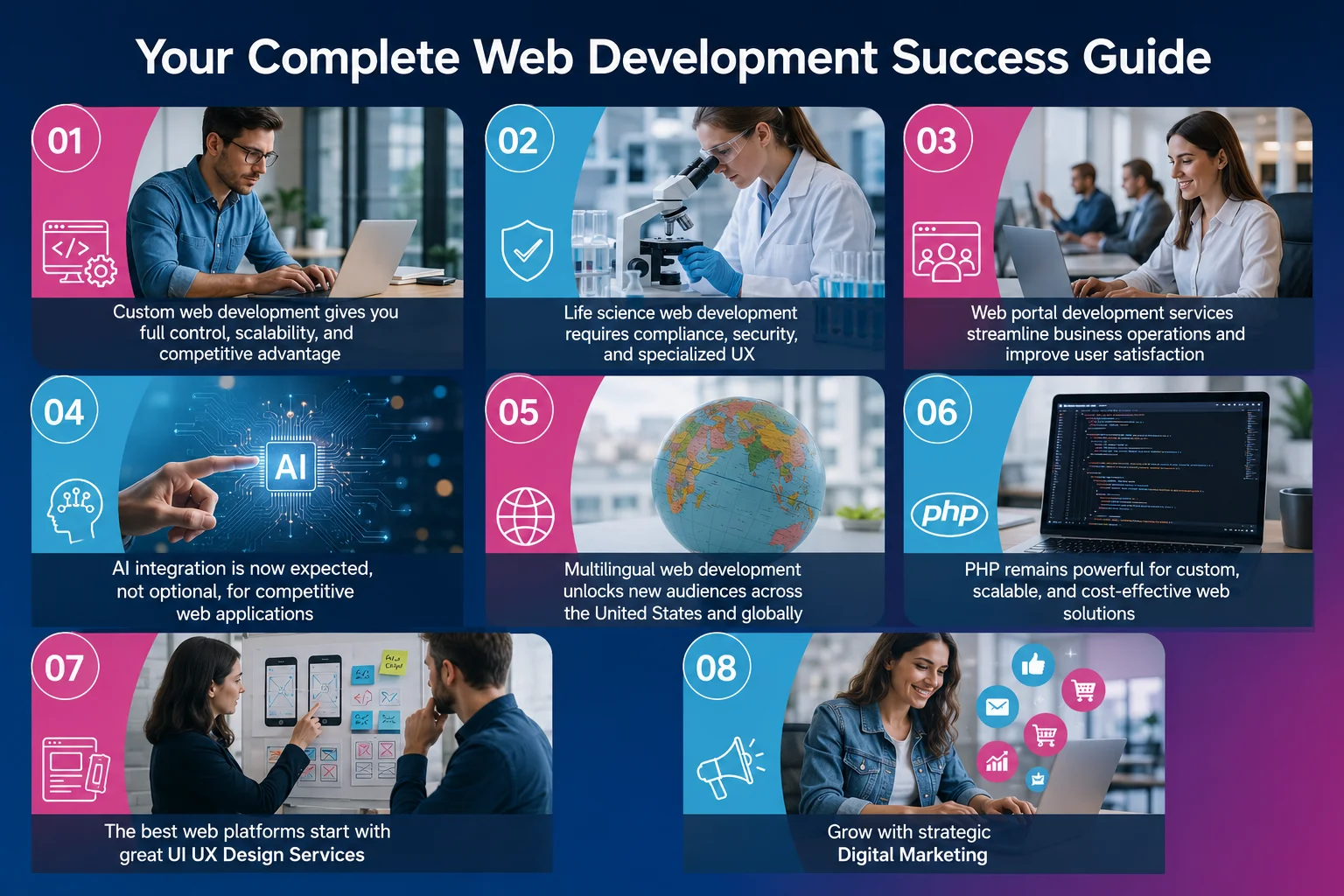
- Custom web development gives you full control, scalability, and competitive advantage
- Life science web development requires compliance, security, and specialized UX
- Web portal development services streamline business operations and improve user satisfaction
- AI integration is now expected, not optional, for competitive web applications
- Multilingual web development unlocks new audiences across the United States and globally
- PHP remains powerful for custom, scalable, and cost-effective web solutions
- The best web platforms start with great UI UX Design Services and grow with strategic Digital Marketing
Frequently Asked Questions (FAQs)
What is the cost of custom web development services?
Costs vary widely based on complexity, features, and team location. In the US, a basic custom web application typically starts around $10,000–$25,000. Enterprise platforms with AI integration and portal features can range from $50,000 to $250,000+. Getting a detailed discovery scope is the best way to get an accurate estimate.
How long does custom web development take?
A standard business website takes 8–12 weeks. A web portal or AI-integrated platform typically takes 16–26 weeks. Life science platforms with compliance requirements may take 6–12 months depending on the regulatory scope.
Do I need custom web development or will a CMS work?
If your needs are straightforward, blog, brochure site, or simple e-commerce, a CMS like WordPress may be sufficient. If you need custom workflows, AI features, complex integrations, or industry-specific compliance, custom development is the right choice.
What makes life science web development different?
Life science web development must meet strict regulatory requirements (HIPAA, FDA 21 CFR Part 11), protect sensitive data, and support complex user roles. It also often involves integration with medical software systems that general-purpose CMS platforms cannot handle.
Can I add AI features to my existing website?
Yes, in many cases. If your existing site is built on a modern framework, AI features like chatbots, recommendation engines, and analytics can be added via APIs. If your platform is older or heavily dependent on templates, a rebuild may be more cost-effective.
What is a web portal and who needs one?
A web portal is a centralized digital hub that provides role-based access to tools, data, and services. Businesses that need portals include healthcare organizations, educational institutions, B2B companies, logistics firms, and any organization managing multiple user groups with different access needs.
Why should I choose custom PHP web development?
Custom PHP development gives you a mature, stable, and widely supported foundation. With frameworks like Laravel and Symfony, PHP can handle anything from complex e-commerce to enterprise portals. It's also cost-effective and has one of the largest developer communities globally.
How does multilingual web development improve SEO?
Multilingual websites with proper hreflang implementation, language-specific URLs, and localized content signal to Google that you're serving different language audiences. This helps you rank in search results for Spanish, Chinese, French, and other language searches, multiplying your organic traffic potential.
For more questions?
Contact Us
Custom web development is not just a technical decision. It's a strategic one. Whether you're building a portal, integrating AI, creating a multilingual platform, or developing for the life science industry, the right custom solution can set your business apart in one of the most competitive digital markets in the world: the United States. The key is partnering with a team that doesn't just write code, but understands your business goals, your users, and the technology trends shaping your industry. From UI UX Design Services and Animations to SEO, SMM, and Mobile Applications, a full-service digital team gives you everything you need to build, launch, and grow a platform that performs. Ready to build something great? Start with a discovery session and let the right team make it happen.